

Try it in your pool for 30 days. Exchange it for another Dolphin for free, or return it with no restocking fee.
Your bag is empty.
By pool surface
Top pick: Dolphin Sigma
$2349 today · Free shipping · 30 day trial
The short answer
Concrete is coarse, often uneven and hard on brushes. Three of our robots name it on their surface lists. Here is how they rank, and where the others stand.
Choose the Dolphin Sigma: four scrubbing brushes, three ProLine motors and a surface list that names concrete make it the strongest cleaner for a coarse pool. The Dolphin Premier also lists concrete and costs less, with a longer 3-hour cycle. The Dolphin Quantum suits concrete finished in plaster or pebble. For a small concrete pool of 33 ft or less, choose the Dolphin Cayman.
'Concrete pool' covers a lot of ground: poured walls, shotcrete shells, older pools that were painted, and pools where the plaster has worn back to something close to bare concrete. What they share is a coarse, porous surface that holds grit and gives algae a foothold. Many are decades old, with settled sections, hairline cracks and floors that are not quite flat.
The best robotic pool cleaner for concrete pools scrubs hard, grips a coarse wall and filters grit without choking. We also checked each robot's published surface list. The Sigma, Premier and Cayman name concrete. The Quantum names gunite, plaster and pebble, the finishes most concrete pools wear. The Escape names neither concrete nor plaster, so it is not a pick here.
Our picks, in order
Temporarily out of stock
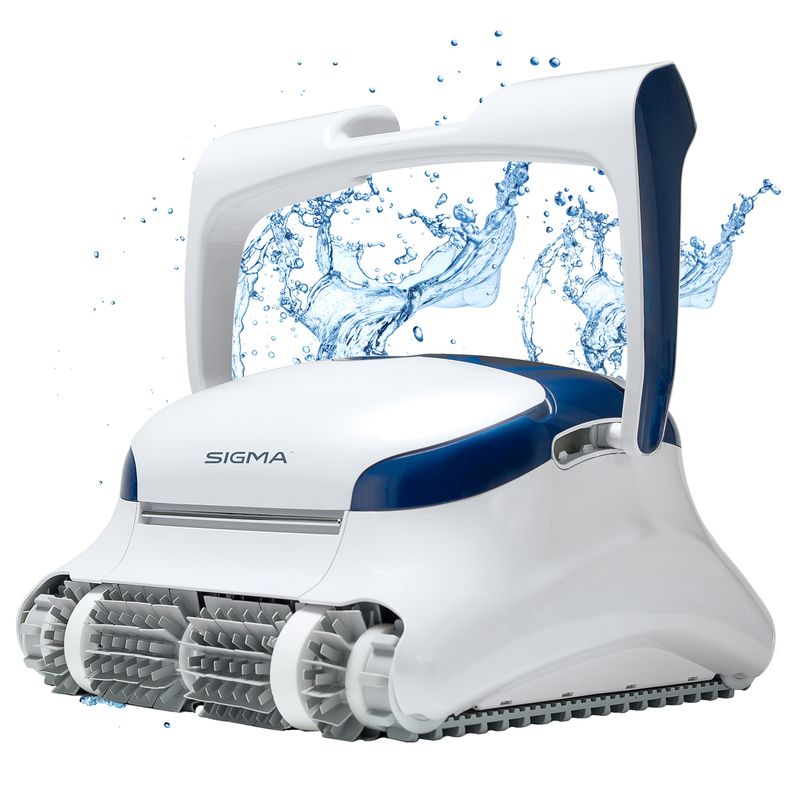
Strongest scrub for coarse concrete
Concrete is on the Sigma's published surface list, and no robot in these guides scrubs it harder. Quad brushes cover more of the surface per pass than a single or dual set, and three commercial-grade ProLine motors keep 4,500 GPH moving through the filters while they work. On a porous floor that lifts what a lighter robot rolls over.
SmartNav 3.0 with an onboard gyroscope helps it keep its bearings when an uneven floor knocks it off line. NanoFilters and standard cartridges are both included, and the app sends a filter alert, useful in a pool that sheds grit.
Temporarily out of stock
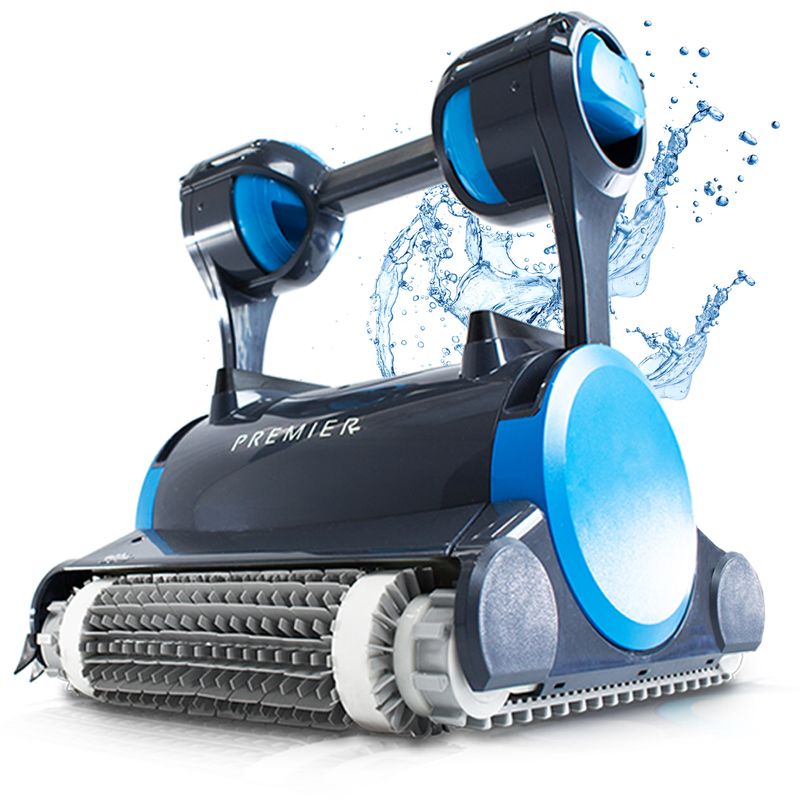
Concrete-listed workhorse with four filter options
The Premier names concrete on its surface list too, and it suits the debris an old concrete pool produces. Multi-Media filtration offers four media options swapped in seconds, with the oversized leaf bag for flakes and coarse grit, standard fine filters for ordinary dirt and NanoFilters for dust all in the box.
Dual scrubbing brushes and two ProLine motors clean over a 3-hour cycle, the longest here, which gives a rough floor more passes. The warranty runs 3 years. It is second only because the leader carries twice the brushes.
Temporarily out of stock
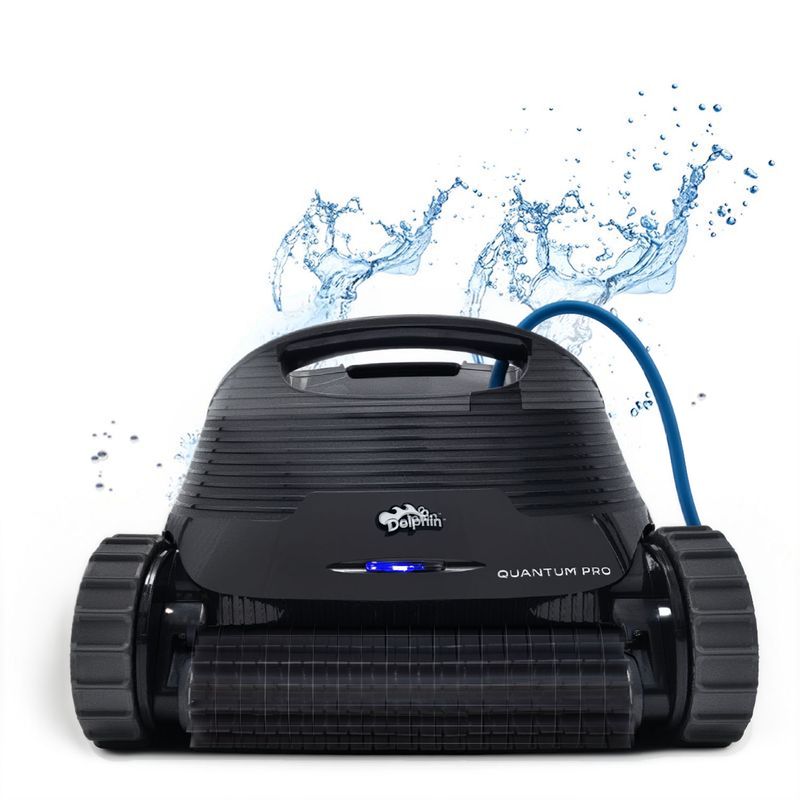
For concrete finished in plaster or pebble
Most concrete pools are not bare. They are finished in plaster or pebble, and both are on the Quantum's published list along with gunite and tile. Raw or painted concrete is not named there, which is why it ranks third on this page and not higher.
On a finished surface it is a strong, lower-priced choice. Both of its HyperBrushes rotate twice as fast as standard brushes, NanoFilter panels come with it, and the XXL MaxBin basket has over 400 square inches of filter area. It is rated to 50 ft and cleans the waterline. The warranty is 2 years.
Temporarily out of stock
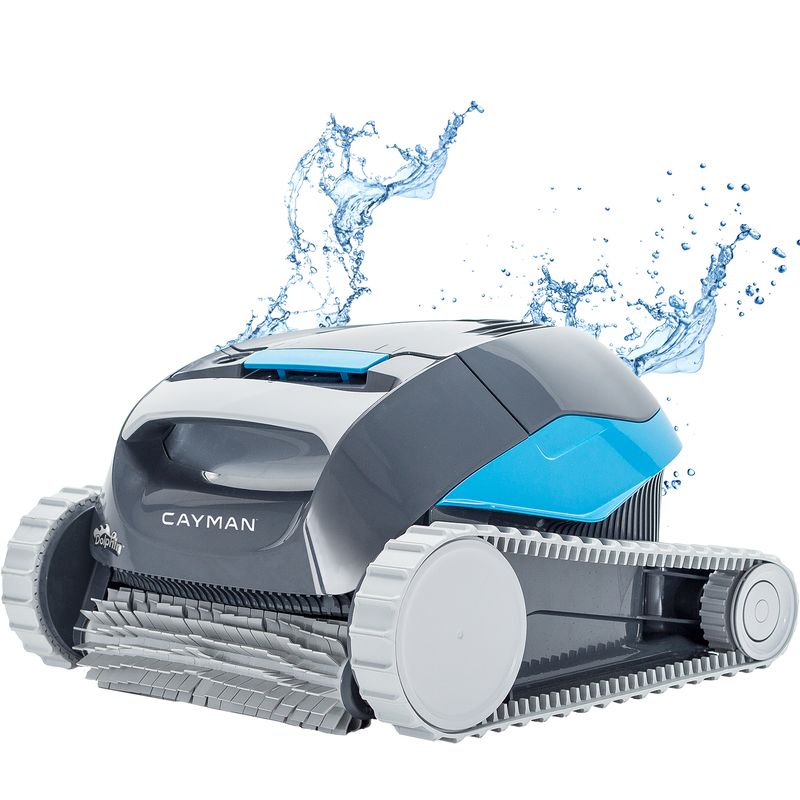
Lists concrete, sized for pools to 33 ft
When the pool is small, the Cayman is the lowest-priced robot whose list names the surface: concrete, plaster, gunite and pebble are all there. Its rating stops at 33 ft. A single HyperBrush on dual 24-volt DC motors takes the floor and walls in 2 hours, and the MaxBin basket, 50 percent larger than a standard Dolphin filter, has room for grit.
Its timer starts a cycle every day, which gives dirt less time to settle into a porous surface. Fourth place reflects three gaps: the waterline is left to you, NanoFilter panels cost extra, and the warranty is 2 years.
How to judge a robot for this
Dirt sits in the pores of concrete, not on top of it. A brush has to work it loose before suction can take it. More brushes and faster brushes do more: four on the Sigma, two on the Premier, two double-speed HyperBrushes on the Quantum.
Rough concrete gives tracks plenty to bite, so climbing is rarely the problem. Uneven floors are. Settled slabs, ridges at old repairs and a raised main drain can hang up a robot. All four picks drive on HyperGrip tracks, which ride over small ridges.
Old concrete sheds. Sand-sized grit, flakes of paint and fine dust all end up on the floor. You want a filter with room for coarse debris and a fine stage for dust. The Premier's four media options cover that range best.
Concrete wears brushes faster than vinyl or fiberglass ever will. That is expected, not a defect. What matters is that the brushes are replaceable and the robot behind them carries a long warranty: 3 years on the Sigma and Premier.
Side by side
| Specification | Dolphin Sigma | Dolphin Premier | Dolphin Quantum | Dolphin Cayman |
|---|---|---|---|---|
| Price today | $2349 | $1949 | $1599 | $1049 |
| Brushes | Quad scrubbing brushes | Dual scrubbing brushes | Dual HyperBrush | HyperBrush |
| Cleans | Floor, walls and waterline | Floor, walls and waterline | Floor, walls, waterline, sun shelves and stairs | Floor and walls |
| Traction | HyperGrip tracks | HyperGrip tracks | HyperGrip tracks | HyperGrip tracks |
| Pool length | Up to 50 ft | Up to 50 ft | Up to 50 ft | Up to 33 ft |
| Filtration | NanoFilters and standard filter cartridges | Multi-Media: NanoFilters, oversized leaf bag and standard fine filters | XXL MaxBin basket with standard and NanoFilter panels | MaxBin basket with fine panels; NanoFilter panels optional |
| Robot weight | 24.6 lb | 20.3 lb | 18.3 lb | 14.6 lb |
| Warranty | 3 years | 3 years | 2 years | 2 years |
Run a hand over the wall below the waterline. What you feel decides which advice applies. If paint is coming off in sheets or plaster is lifting, that is a resurfacing job. A robot keeps the floor clear of the debris. It does not slow the failure.
Old concrete moves. Hairline cracks are cosmetic as far as a robot is concerned: tracks roll straight over them. Wider cracks, lifted patches and a lip where two pours meet are different. A robot can pivot on a ridge or stop against it, and loose material at a crack edge ends up in the filter.
Walk the floor before the first run and note anything that sticks up noticeably from the surface. Raised main-drain covers are the most common snag. The Quantum's navigation senses drains and ladders. The Sigma's gyroscope helps it recover its heading. If a robot keeps stopping in one place, the floor is telling you something, and a repair is the fix.
Stains are not debris. Rust blooms from reinforcing steel, calcium deposits weeping from a crack and discolored patches in old plaster all stay put however often a robot passes over them. They are repair and water-chemistry work.
Algae is a half case. Brushes knock loose what sits on the surface and fine filters catch it, which keeps a coarse pool cleaner between treatments. Growth that has taken hold in the pores still needs sanitizer and a stiff brush on a pole. And no robot replaces the skimmer for what floats.
Questions, answered
Of the five robots we sell, the Sigma, Premier and Cayman name concrete on their published surface lists. The Quantum's list names gunite, plaster, pebble and tile, which covers a concrete pool with one of those finishes. The Escape's list has four entries and concrete is not one of them, so we do not recommend it here.
Sound paint is a surface a brush simply cleans. Paint that is already letting go is another matter: brushes lift the loose flakes and the filter fills with them. That is a sign the coating is near the end of its life. Use a coarse filter, empty it often, and plan the repaint.
Hairline cracks, yes. Tracks roll over them without noticing. A wide crack with a raised edge, or a patch that has lifted, can stop a robot or tip it, and loose concrete at the edge goes into the filter. Have structural cracks looked at for their own sake. The robot is the least of the reasons.
Rarely. Gunite and shotcrete are concrete applied by spraying, and poured concrete is the same material placed in forms. All are normally finished in plaster, pebble or tile, and the robot cleans the finish. The difference shows only when the concrete is bare or painted. Then pick a robot whose surface list names concrete.
The verdict
Find out what the surface is, then measure the pool. Bare or painted concrete: the Sigma for the hardest scrub, the Premier for the widest filtering and the longest cycle. Plaster or pebble over concrete, in a pool longer than 33 ft: the Quantum is the value choice. Any concrete pool of 33 ft or less: the Cayman. If you are not sure what you have, talk to a Dolphin Expert before you order.
Keep reading
