

Try it in your pool for 30 days. Exchange it for another Dolphin for free, or return it with no restocking fee.
Your bag is empty.
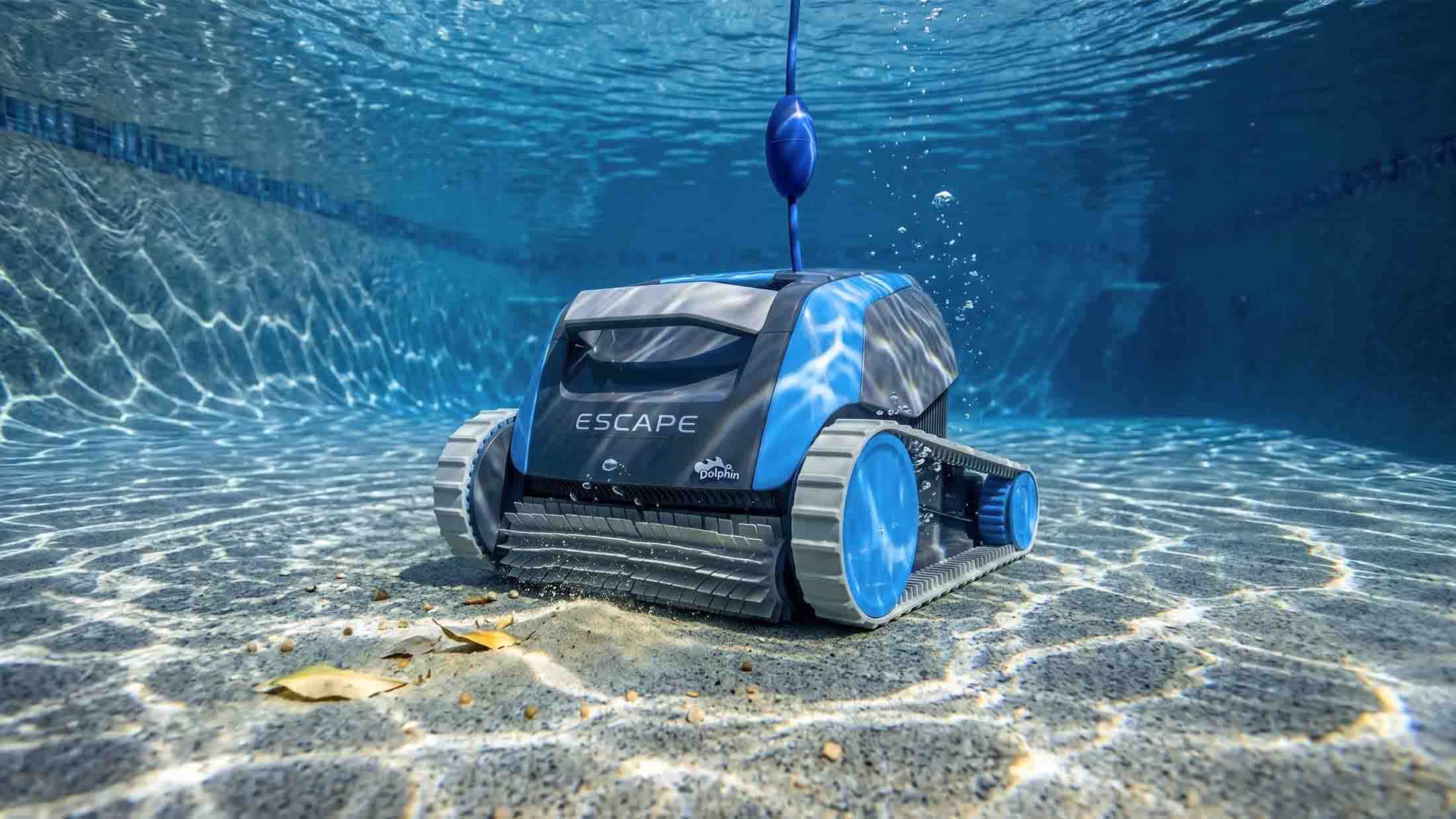
By steps, ledges and tricky features
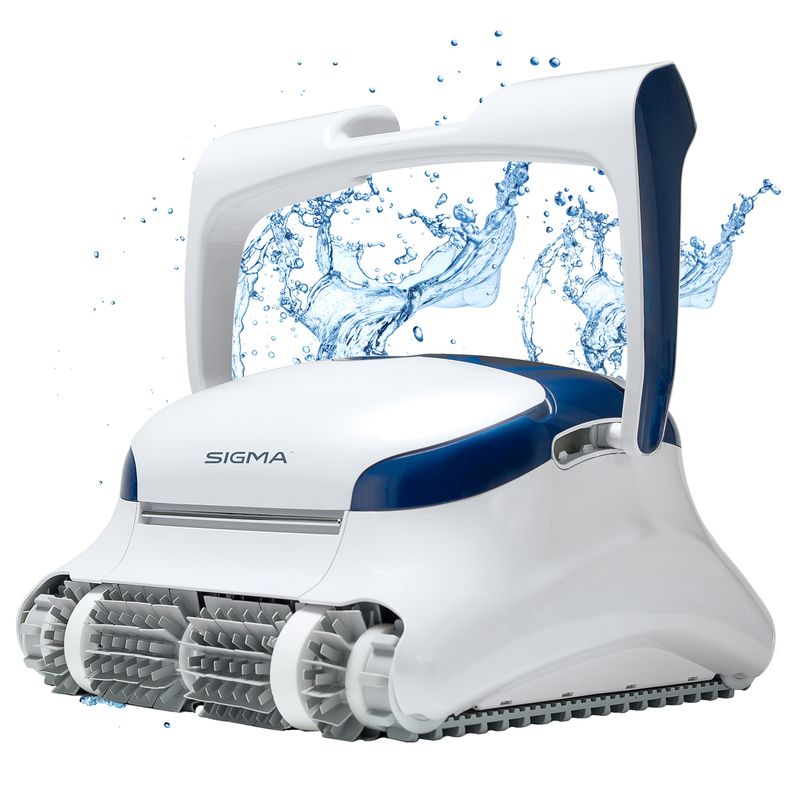
Top pick: Dolphin Sigma
$2349 today · Free shipping · 30 day trial
The short answer
Tracks cope with a normal slope; what separates robots is whether they keep their heading on it or drift back to the deep end.
The Dolphin Sigma is the pick for sloped floors: its gyroscope senses the incline and holds its line, so it does not keep sliding back to re-clean the deep end. The Dolphin Premier and Dolphin Quantum rely on SmartNav 2.0 scanning and track grip, and do fine on standard slopes over a full cycle. For pools up to 33 ft, the Dolphin Escape handles an ordinary shallow-to-deep break for the least money.
Nearly every in-ground pool has a slope somewhere: the break from the shallow end to the deep end, the funnel of a hopper bottom, or the shallow V of a sport pool. Owners worry that a robot will slip on it. That is rarely the problem. Rubber tracks grip a normal transition slope without trouble, so the best robotic pool cleaner for sloped pools is not simply the one with the most grip.
The real failure is quieter. A robot crossing a slope gets nudged downhill, loses its heading, and ends up cleaning the deep end again and again while the shallow end waits. The right robot is the one that knows where it is pointing, and the next best is one with enough cycle time to even things out. The same ranking answers a search for the best robotic pool cleaner for steep slopes.
Our picks, in order
Temporarily out of stock
Senses the incline and holds its line
The Sigma is first because it is the only robot in this guide with a gyroscope. SmartNav 3.0 uses it to sense the incline as the robot crosses the break, so it holds its line instead of curving back downhill. That is the difference between a floor cleaned evenly and a deep end cleaned over and over.
The rest of the machine suits a big sloped pool: three ProLine motors moving 4,500 GPH, four scrubbing brushes, a 2.5-hour cycle, a 55 ft cable with a 360-degree swivel and a 3-year warranty.
Temporarily out of stock
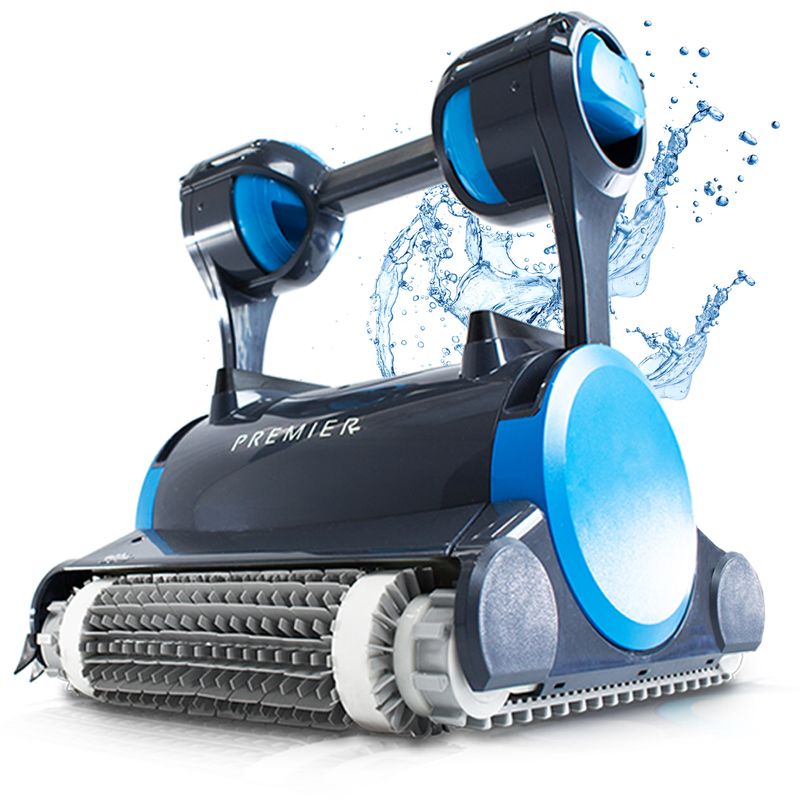
Three hours to even out a hopper bottom
The Premier does not sense tilt. It makes up for that with time and traction. SmartNav 2.0 scanning plans its coverage, HyperGrip tracks hold the slope, and its 3-hour cycle, which no other robot in this guide matches, gives it more time on the break than any other pick. Over a full cycle on a standard slope, that is enough.
It also deals with what a slope does to debris. Leaves and grit roll downhill and settle at the bottom, and the Premier's oversized leaf bag and 4,500 GPH are suited to that pile.
Temporarily out of stock
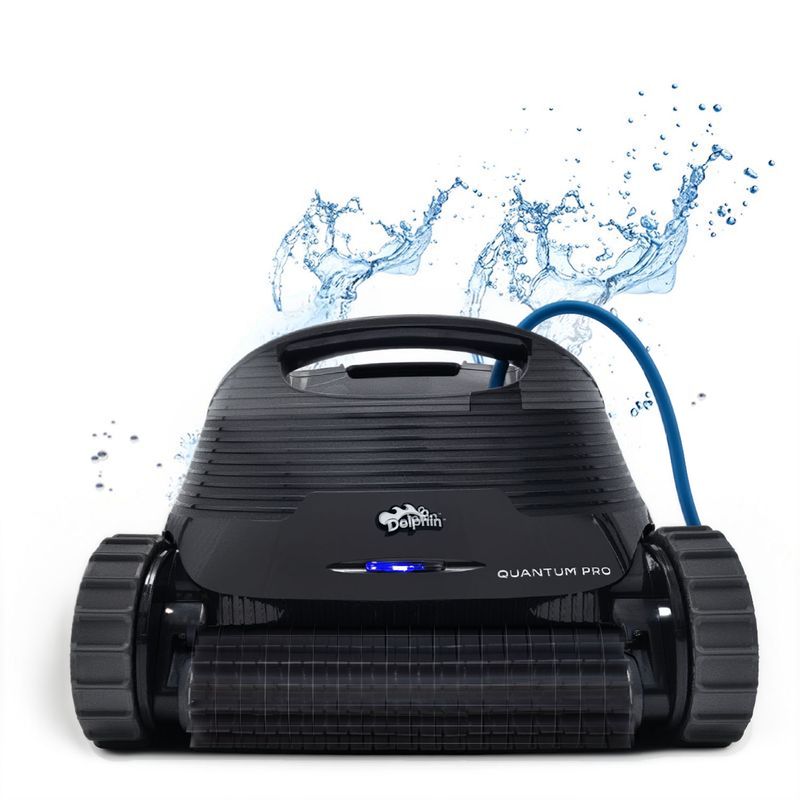
Scanning and grip for the lowest 50 ft price
The Quantum uses the same SmartNav 2.0 scanning approach as the Premier, on HyperGrip continuous rubber tracks, and it does fine on a standard break over its 2-hour cycle. It is the lowest-priced 50 ft robot in this guide, so for a pool with one ordinary slope it is the sensible place to stop spending.
It weighs 18.3 lb, less than either of the other 50 ft picks. Its timer can run every day, on the power supply or in the app, which is the cheap way to make sure both ends get covered.

Temporarily out of stock
Ordinary slopes in pools up to 33 ft
The Escape runs on the same HyperGrip tracks and the same SmartNav 2.0 scanning as picks that cost far more. On a pool of 33 ft or less with one standard break from shallow to deep, that is what the job takes. It is fourth because its 1.5-hour cycle leaves the least time to recover from drifting downhill, not because it cannot climb the slope.
It is also the pick for above-ground pools with a dished floor or a deep-end liner, where no 50 ft robot belongs. No robot in this guide is lighter, at 14.2 lb.
How to judge a robot for this
Gravity pulls a robot off course every time it crosses a slope at an angle. Without a way to sense that, it drifts toward the deep end and repeats ground it has covered. A gyroscope measures the tilt directly. Scanning navigation corrects more gradually, over the course of the cycle.
Every pick here drives on HyperGrip tracks, and tracks hold a slope better than wheels because the whole length of the belt is in contact with the surface. On a standard shallow-to-deep break, grip is not what separates these robots.
A robot that wanders needs time to make up for it. Cycle lengths here run from 3 hours on the Premier and 2.5 on the Sigma down to 2 on the Quantum and 1.5 on the Escape. The longer the cycle, the more chances a scanning robot has to get back up the slope and finish the shallow end.
A transition slope is one thing. The sides of a hopper bottom can be steep enough that a robot treats them as walls and climbs them like walls, which all four picks do.
Side by side
| Specification | Dolphin Sigma | Dolphin Premier | Dolphin Quantum | Dolphin Escape |
|---|---|---|---|---|
| Price today | $2349 | $1949 | $1599 | $659 |
| Cleans | Floor, walls and waterline | Floor, walls and waterline | Floor, walls, waterline, sun shelves and stairs | Floor and walls |
| Traction | HyperGrip tracks | HyperGrip tracks | HyperGrip tracks | HyperGrip tracks |
| Navigation | SmartNav 3.0 with gyroscope | SmartNav 2.0 | SmartNav 2.0 | SmartNav 2.0 |
| Cable | 55 ft with 360° anti-tangle swivel | 55 ft with 360° anti-tangle swivel | 55 ft with anti-tangle swivel | 40 ft |
| Robot weight | 24.6 lb | 20.3 lb | 18.3 lb | 14.2 lb |
| Warranty | 3 years | 3 years | 2 years | 2 years |
Several floor shapes get called sloped, and they are not equally demanding.
If the shallow end still looks dusty after a cycle while the deep end is spotless, the robot is losing the slope. Set the power supply along the long side, between the middle and the deep end, so the cable reaches both ends without pulling tight. Lay the cable out straight to remove twists, which tug a robot off its heading. And judge by several cycles, not one.
If the pattern persists on a pool with a steep or complex floor, that is the case for the Sigma.
Vinyl liner is on the published surface list of every pick here, and a sound liner on a slope is ordinary work. The thing to check is fit. On a steep hopper, a liner that has stretched or pulled away can bunch into folds at the foot of the slope, and a fold is an obstacle to tracks and brushes alike. Press along the slope with a pool brush: if the liner stays tight to the floor, carry on. If it shifts or wrinkles, have it looked at first. No robot will pull it flat.
Questions, answered
Yes. All four picks drive on rubber tracks and climb walls. Getting up the slope is not the hard part. Staying on course while crossing it is, and that is what separates a robot with a gyroscope from one that relies on scanning and time.
Not for a standard break. The Premier, Quantum and Escape have no gyroscope and do fine on a normal shallow-to-deep slope over a full cycle. It earns its cost on hopper bottoms, long steep breaks and floors that slope more than one way, where a robot without one is more likely to drift.
Yes, provided the liner is tight. Vinyl is a published surface for every pick here, and the steep sides of a hopper are climbed like walls. Check for loose or bunched liner at the foot of the slope first, because folds stop a robot. For a steep vinyl hopper in a pool over 33 ft, we would choose the Sigma.
There is no published angle, so we will not give one. A robot that climbs vertical walls is not stopped by steepness: gentle and moderate slopes are driven as floor, and the steepest hopper sides are climbed as walls. What suffers on steep ground is heading, not grip.
The verdict
Match the robot to how hard the slope is, not to the fact that there is one. Steep hopper, long break or a floor that tilts several ways: the Sigma, for the gyroscope. One ordinary break in a pool over 33 ft: the Quantum, or the Premier if leaves pile up at the bottom. One ordinary break in a pool of 33 ft or less: the Escape is enough. You have a 30 day in-pool trial to see how it handles your slope.
Keep reading
