

Try it in your pool for 30 days. Exchange it for another Dolphin for free, or return it with no restocking fee.
Your bag is empty.
By pool type and installation
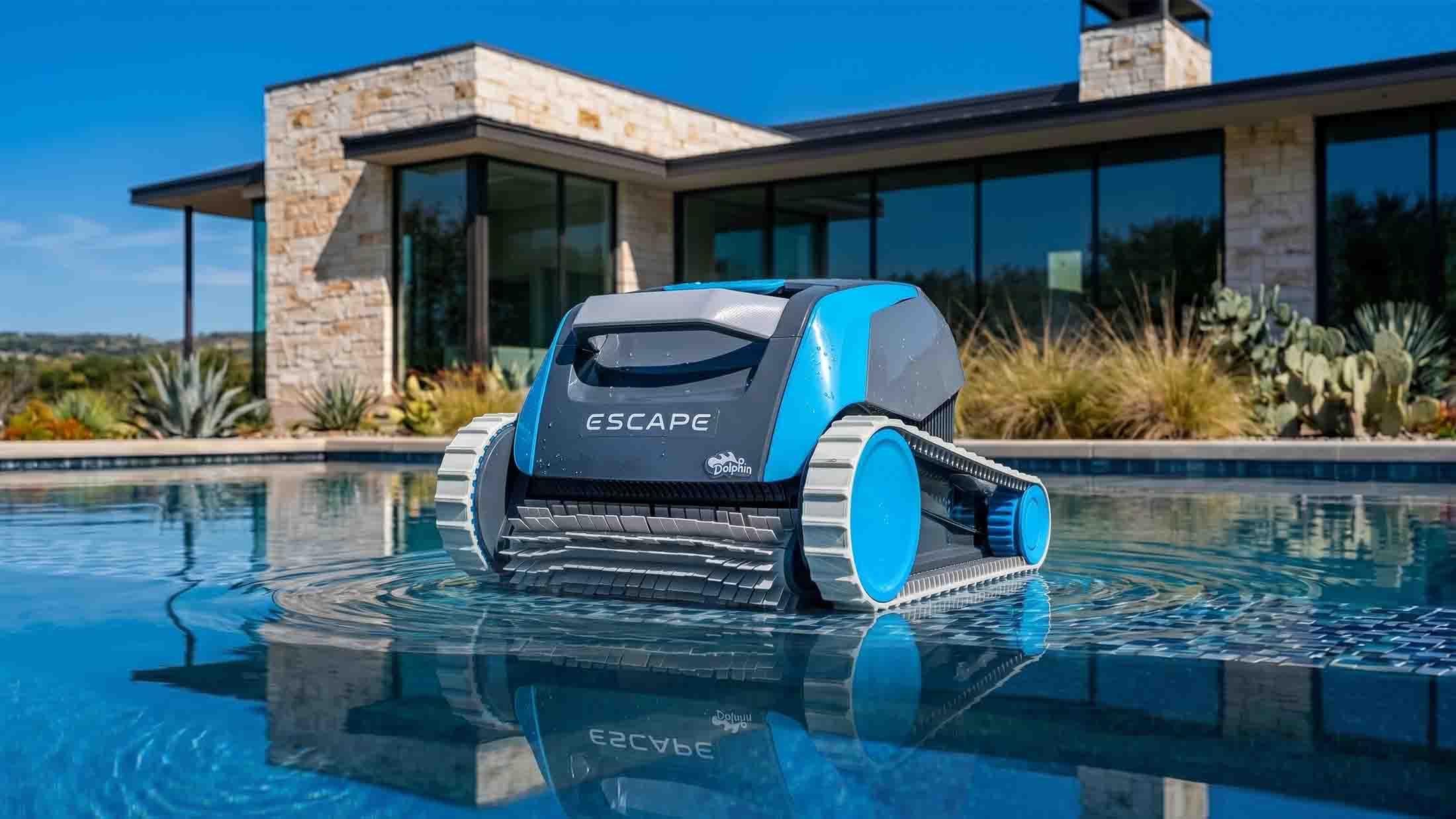
Top pick: Dolphin Escape
$659 today · Free shipping · 30 day trial
The short answer
A semi-inground pool looks built-in but is made like an above-ground pool, and that decides the robot. Two Dolphins are rated for it. Here is how to choose between them.
The Dolphin Escape is the pick for most semi-inground pools: it is rated for above-ground and in-ground construction up to 33 ft, cleans floor and walls in 1.5 hours and costs the least. Choose the Dolphin Cayman instead for a deeper or larger install, a long cable run across decking, or a timer in the box.
A semi-inground pool is a steel, aluminum or resin-wall pool with a vinyl liner, set partly into the ground. Some are sunk a foot or two to tame a sloping yard. Others, including Radiant-style insulated panel pools, go almost fully in and are finished with decking and coping. Either way, picking the best robotic pool cleaner for semi-inground pools has a simple starting point: under the landscaping, it is built like an above-ground pool.
That matters because robots are published for pool types. The two robots here rated for above-ground-style construction are the Escape and the Cayman. Both clean floor and walls, both are rated to 33 ft, and most semi-inground pools are flat-bottomed and inside that length. The in-ground ProLine robots are not listed for this kind of pool, so they are not picks.
Our picks, in order

Temporarily out of stock
The least robot that fits, and usually enough
A semi-inground pool is the kind of pool the Escape was designed around, set a little lower. Its rating covers above-ground and in-ground construction alike, up to 33 ft, and vinyl liner is on its published surface list. A cycle takes 1.5 hours and covers floor and walls. The single HyperBrush turns at twice the speed of standard Dolphin brushes, and HyperGrip tracks carry the robot up the wall. Walls braced by backfill tend to be firm, which helps any wall-climbing robot.
The MaxBin basket, 50% larger than standard Dolphin filters, loads from the top. At 14.2 lb the robot is the lighter of the two, which you will notice when you lift it over coping. It is also the lower-priced pick. What you do not get is a timer in the box or a long cable: 40 ft, no swivel.
Temporarily out of stock
The step up for deeper, bigger or decked-in pools
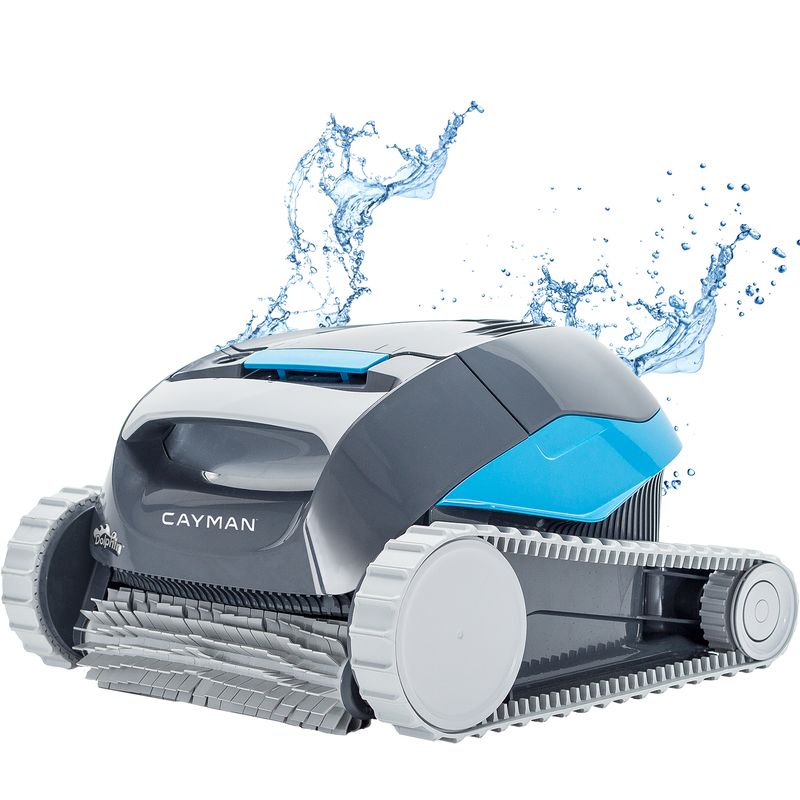
The Cayman is rated for the same pools, in-ground and above-ground up to 33 ft, and it fixes the three things that can catch the Escape out on a permanent install. The cable is 50 ft, ten more to cross a deck or reach the bottom of a hopper. A timer is built in and runs the robot every day. And steps, ladders, drain covers and ledges are on its published obstacle list, which matters if your pool has walk-in steps.
The cycle is 2 hours, half an hour longer, for the same floor-and-wall coverage with the same style of HyperBrush. The MaxBin basket empties through a top hatch. At 14.6 lb the lift is nearly identical. It costs more, so buy it for one of those three reasons, not by default.
How to judge a robot for this
Wall panels, a track and a vinyl liner make it an above-ground-style pool, however deep it sits. Choose a robot published for above-ground pools. The Escape and the Cayman both are, and both are rated for in-ground use as well.
Both picks are rated for pools up to 33 ft, measured along the longest straight run. Most semi-inground rounds and ovals fit. A few long ovals and rectangles do not, and those need a phone call, not a guess.
Buried pools tend to gain decking, which pushes the power supply further from the water. The Escape has a 40 ft cable and the Cayman 50 ft. Neither has a swivel. Measure the route before you choose.
Most are flat-bottomed. Some have a dished center or a deep-end hopper, which adds wall height and uses more cable. HyperGrip tracks on both picks handle the slope. For maximum depth, check the manual.
Permanent pools get used daily, and a timer saves starting the robot by hand. The Cayman has one built in that runs every day. The Escape has none as standard: the Automation Timer power supply is an optional upgrade.
Side by side
| Specification | Dolphin Escape | Dolphin Cayman |
|---|---|---|
| Price today | $659 | $1049 |
| Pool type | Above-ground and in-ground | In-ground and above-ground |
| Pool length | Up to 33 ft | Up to 33 ft |
| Cleans | Floor and walls | Floor and walls |
| Cable | 40 ft | 50 ft |
| Filtration | MaxBin basket; NanoFilter panels optional | MaxBin basket with fine panels; NanoFilter panels optional |
| Robot weight | 14.2 lb | 14.6 lb |
| Warranty | 2 years | 2 years |
The test is what the wall is made of. If the pool has steel, aluminum or resin wall panels with a vinyl liner hung inside, it is an above-ground-style pool, however much of it is below grade. Insulated panel pools belong here too. If the shell is poured concrete, gunite or one-piece fiberglass, it is an in-ground pool and a different guide applies.
This is why the in-ground ProLine robots are not picks on this page: the Premier, Sigma and Quantum are published for in-ground pools only.
Decide where the power supply will sit. It has to stand back from the water by the distance in the manual. Then measure from that spot to the farthest point of the pool wall, and add the depth.
Purely as an example, assume a setback of roughly 12 ft, then use the figure your own manual gives. On an 18 ft round, the far wall is about 30 ft from the power supply, and the Escape's 40 ft cable has room to spare. On a 27 ft round it is about 39 ft before depth, and the Cayman's 50 ft cable is the safer choice. The Escape's 33 ft rating stands. The cable is simply the thing to measure, most of all on rounds larger than about 24 ft.
Some semi-inground ovals and rectangles run longer than 33 ft. That puts them outside the rating of both picks, and we will not stretch it. The 50 ft robots are in-ground machines and are not listed for this construction, so we will not point you to one from a web page either.
The right move is to ask. Talk to a Dolphin Expert with the pool's make, wall type, length and depth to hand, and we will tell you what is and is not published for it.
On a timer, the robot can stay in the water between scheduled cycles. Lift it out at least once a week to empty and rinse the basket, more often when leaves are falling. Take it out before shocking or adding chemicals. If the pool is going to sit unused for a long stretch, keep the robot out of the water and out of direct sun.
Before each run, float the cable out straight. Every few cycles, unplug and stretch it along the deck to let the twists run out. Neither pick has a swivel, and this two-minute habit replaces one.
Questions, answered
Above-ground. What counts is the construction: wall panels and a vinyl liner. How far the pool is sunk does not change that. Choose a robot published for above-ground pools, which here means the Escape or the Cayman. Both are also rated for in-ground use, so a deep install is covered.
We do not recommend it. The Premier, Sigma and Quantum are published for in-ground pools, not for panel-and-liner construction. They might clean it, but that is a guess, and a guess is a poor reason to pay more. If your pool is over 33 ft, call us and we will go through the options.
Both picks are made to clean floor and walls. Walls supported by backfill are usually firm, which helps. How high a robot climbs still varies with the wall and the liner. Expect a clean floor and lower wall as the baseline, and wipe the waterline by hand, because neither robot scrubs it.
The Cayman. A hopper or deep end adds wall height and uses more cable, and the Cayman has 50 ft against the Escape's 40. Both are rated to 33 ft in length. For the maximum depth either robot is made for, check the manual.
If you want the robot to run without you, yes. The Escape has no timer as standard. The optional Automation Timer power supply starts a cycle every 24, 48 or 72 hours. If you want daily cleaning and nothing else, the Cayman's built-in timer does that with no add-on.
Not to the robot. It only ever touches the vinyl liner, and vinyl liner is on the published surface list for both picks. What does matter is the liner's condition. Wrinkles, loose seams and a soft floor base affect any robot, so fix those before blaming the machine.
The verdict
Treat a semi-inground pool as what it is: an above-ground pool with better landscaping. Up to 33 ft, the Escape is the lowest-cost way to do the job properly, provided the 40 ft cable reaches. Move to the Cayman for a named reason: a deep end, a deck that pushes the power supply back, walk-in steps, or a built-in daily timer. Over 33 ft, do not guess. Call.
Keep reading
