

Try it in your pool for 30 days. Exchange it for another Dolphin for free, or return it with no restocking fee.
Your bag is empty.
By debris and dirt problem
Top pick: Dolphin Premier
$1949 today · Free shipping · 30 day trial
The short answer
Seed pods, blossoms, mulch and small sticks jam fine filters and fill small ones, so here are the robots with room for them and the things every robot leaves on the floor.
The best robotic pool cleaner for large debris is the Dolphin Premier, because its Multi-Media set includes an oversized leaf bag that takes bulky material without clogging. The Dolphin Quantum runs it close with the XXL MaxBin, the largest basket of the four. In pools up to 33 ft, the Dolphin Escape takes ordinary large debris in its MaxBin for the lowest price. The Dolphin Cayman does the same and adds a daily timer.
Large debris is the stuff you can pick up with your fingers: whole leaves, magnolia and sweetgum pods, spent blossoms, mulch washed in by a storm, small sticks, and whatever the kids left behind. None of it is hard to lift. The difficulty is where it goes. Bulky pieces bridge across a fine filter and seal it, and a small basket is full after one lap of the pool.
So the robots that do well here have two things: an open path from the floor into the robot, and a large, coarse container at the end of it. Brush count and navigation matter less. And every robot has a ceiling. Anything bigger than the intake stays where it is until a person removes it, and we will be specific about what that includes.
Our picks, in order
Temporarily out of stock
A bag of its own for bulky debris
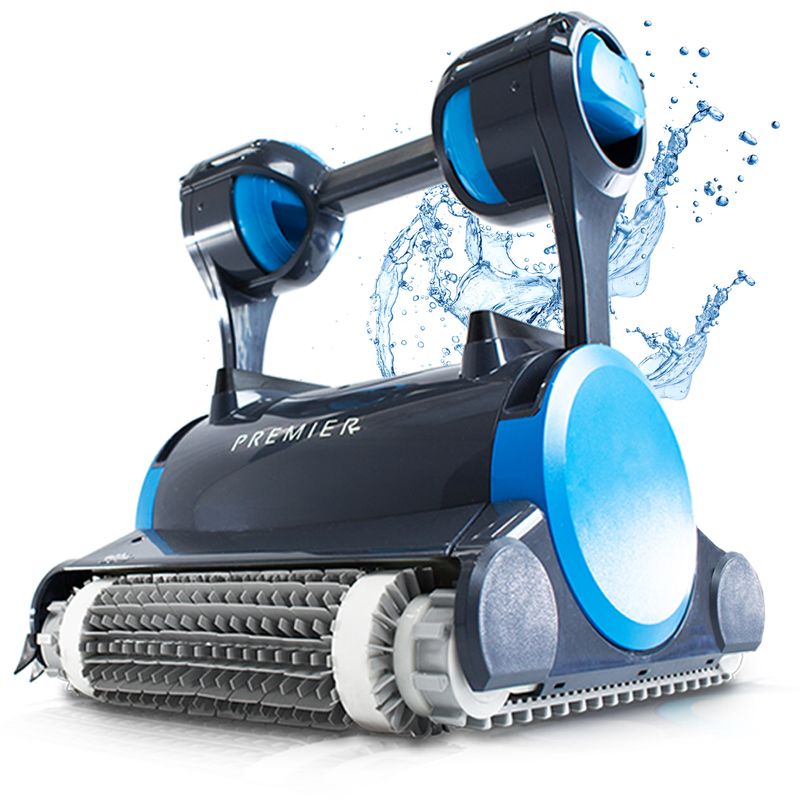
The Premier leads because its Multi-Media set gives bulky debris a container of its own. The oversized leaf bag takes seed pods, blossoms, mulch and whole leaves, with room for awkward shapes to settle instead of packing against a fine screen, and 4,500 gallons per hour from two commercial-grade ProLine motors carries heavier pieces in. For the dirtiest jobs there is an optional fourth medium, disposable debris bags, so a storm load goes straight in the trash. The standard fine filters and NanoFilters that are also included handle everything smaller.
Temporarily out of stock
Largest open basket on the page
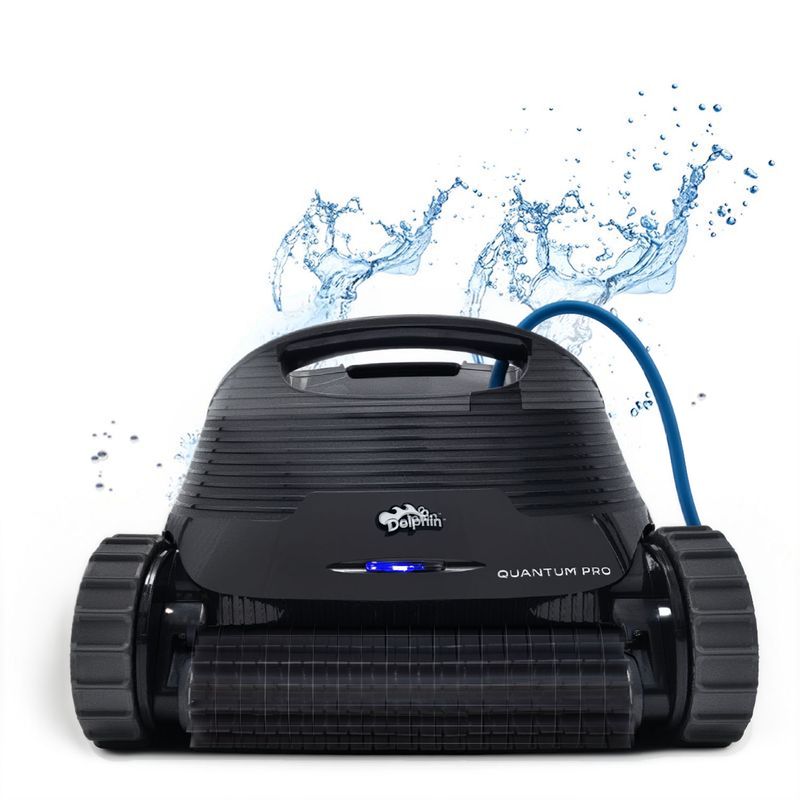
The Quantum and the Premier are close on this job, and plenty of owners will prefer the Quantum. Its XXL MaxBin is a rigid, open basket with over 400 square inches of filter area, and it opens from the top with one click, so a load of pods and sticks tips straight into a bin. Fit the standard panels for bulk and keep the included NanoFilter panels for later. It also works sun shelves, Baja ledges and stairs, where blossoms and seed cases tend to settle, and it costs less than the Premier.

Temporarily out of stock
Ordinary large debris, pools to 33 ft
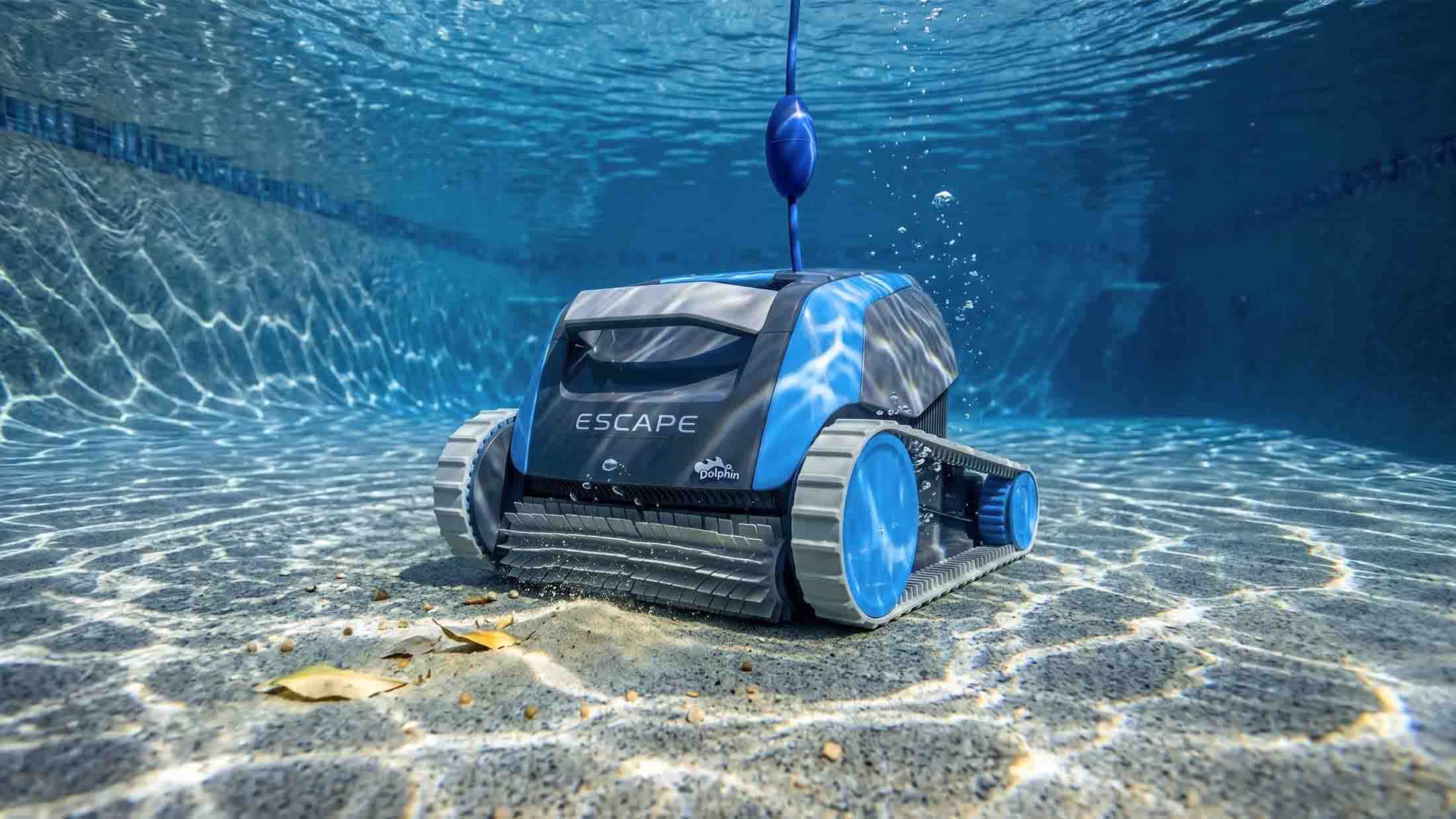
The Escape has the same kind of open, top-load basket as the bigger robots, scaled for a smaller pool. The MaxBin is 50% larger than standard Dolphin filters, and dual 24-volt DC motors pull over 4,000 gallons per hour through it, so whole leaves, flowers and seed pods go in without fuss. On an above-ground pool or a small in-ground one, that is all the capacity the job calls for. It weighs 14.2 lb, finishes in 1.5 hours and is the least expensive robot here.
Temporarily out of stock
Same basket class, with a daily timer
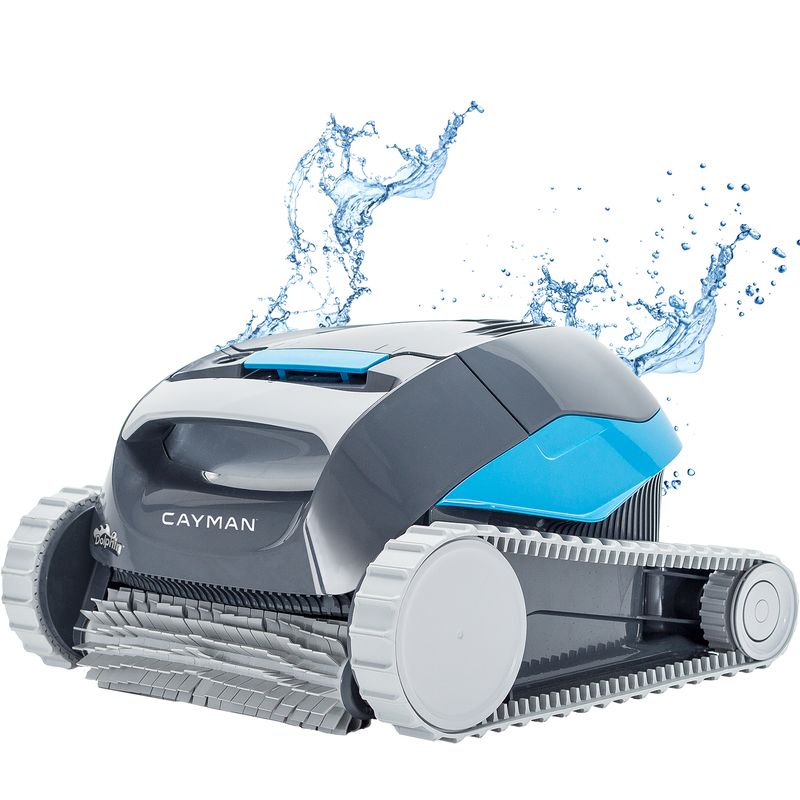
The Cayman carries the MaxBin as well, emptied through a top hatch with one tab, and the same dual 24-volt DC motors moving over 4,000 gallons per hour. For large debris the two are equals. The Cayman is fourth only because it costs more, and what the extra buys is not capacity: a timer on the power supply that runs it every day, a 2-hour cycle and a 50 ft cable. A daily run is worth having under a tree that drops something every afternoon, since one day's debris always fits the basket.
How to judge a robot for this
Volume decides how long a robot works before it stops collecting. Two containers stand out: the oversized leaf bag in the Premier's Multi-Media set, and the XXL MaxBin on the Quantum, which has more than 400 square inches of filter area. The MaxBin on the Escape and Cayman is smaller, and enough for ordinary large debris in a pool up to 33 ft.
Ultra-fine filters are made for silt, and a seed pod or a wad of blossoms blinds them almost at once. For bulky debris use the leaf bag or the standard panels. Keep NanoFilters out of the robot until the big material is gone.
Sticks and pods tangle. Getting them out is easier when the whole basket or bag lifts out of the top of the robot and can be shaken over a bin. The Premier, Quantum and Escape are top-load, and the Cayman empties through a top hatch with one tab.
A waterlogged pod or a clump of mulch is heavier than a leaf. The Premier moves 4,500 gallons per hour and the Quantum 4,000. The Escape and Cayman each move over 4,000 on dual 24-volt DC motors. All of that is ample for anything that fits the intake.
Side by side
| Specification | Dolphin Premier | Dolphin Quantum | Dolphin Escape | Dolphin Cayman |
|---|---|---|---|---|
| Price today | $1949 | $1599 | $659 | $1049 |
| Filtration | Multi-Media: NanoFilters, oversized leaf bag and standard fine filters | XXL MaxBin basket with standard and NanoFilter panels | MaxBin basket; NanoFilter panels optional | MaxBin basket with fine panels; NanoFilter panels optional |
| Filter access | Top-load, no tools | Top-load, one-click open | Top-load | Top hatch, one-tab emptying |
| Brushes | Dual scrubbing brushes | Dual HyperBrush | HyperBrush | HyperBrush |
| Flow rate | 4,500 GPH | 4,000 GPH | Over 4,000 GPH | Over 4,000 GPH |
| Cycle time | 3 hours | 2 hours | 1.5 hours | 2 hours |
| Cleans | Floor, walls and waterline | Floor, walls, waterline, sun shelves and stairs | Floor and walls | Floor and walls |
| Scheduling | Weekly timer: every day, every 2 days or every 3 days | Weekly timer: every day, every 2 days or every 3 days | Optional Automation Timer: every 24, 48 or 72 hours | Timer: every day |
| Warranty | 3 years | 2 years | 2 years | 2 years |
A robot collects what passes through its intake and into the filter. That covers most of what trees and weather put in a pool. It does not cover everything, and running a robot over the wrong object is how filters tear and impellers jam. Walk the pool first.
Soft debris fills a robot. Hard debris can stop it. A pebble, a screw or a chip of broken tile can be drawn in with the flow and lodge in the impeller, the small fan that moves water through the robot. The sign is a robot that still drives but no longer pulls.
If that happens, unplug the power supply before you touch anything, then follow the manual's steps for clearing the impeller. Do not run the robot again until the object is out. The better habit is prevention: after wind, a storm or yard work, look at the floor and pick up anything hard before the cycle starts.
Questions, answered
Anything that passes through the intake on the underside of the robot and fits in the basket or bag. In practice that means whole leaves, seed pods, blossoms, acorns and small twigs. No intake measurement is published, so use a simple rule: if it is long, rigid or heavy, take it out yourself.
It may draw them in, and that is the problem. Stones and other hard objects can jam the impeller or tear filter media. Pick up rocks, gravel and hardware by hand before a cycle. If the robot stops pulling water after running over gravel, unplug it and clear the impeller as the manual describes.
Short twigs usually pass into the basket with the leaves. Longer or forked sticks can lodge across the intake or in a brush, and then the robot leaves a trail until they are removed. Net out anything stick-sized before the cycle, and check the intake when you empty.
No, but it fills the filter quickly and sheds a fine brown dust as it soaks. Collect mulch with standard panels or the leaf bag, empty as soon as the cycle ends, then run one more cycle with fine filters for the dust. If mulch washes in every time it rains, edging the bed will save more work than any robot.
It picks up large debris, and it is a fine robot. But its filters are cartridges designed with fine debris in mind, so they hold less bulk than a leaf bag or a MaxBin, and it costs more than any robot on this page. For bulky debris the money is better spent on capacity.
The verdict
Large debris is simple to buy for. In a pool longer than 33 ft, choose the Premier if you want a bag for the worst loads, or the Quantum if you would rather tip the biggest basket. At 33 ft and under, the Escape has the capacity the job needs, and the Cayman adds a daily run. Then do the part no robot does: pick up the branches, fronds and stones before you press start.
Keep reading
