

Try it in your pool for 30 days. Exchange it for another Dolphin for free, or return it with no restocking fee.
Your bag is empty.
By debris and dirt problem
Top pick: Dolphin Premier
$1949 today · Free shipping · 30 day trial
The short answer
Silt, dust, pollen and dead algae pass through an ordinary filter and settle again overnight, so filter fineness decides the ranking, at the cost of a rinse after every cycle.
The best robotic pool cleaner for fine debris is the Dolphin Premier: NanoFilters are included, and its Multi-Media set lets you change to coarser filters when leaves arrive. The Dolphin Sigma also includes NanoFilters and scrubs harder, for more money. The Dolphin Quantum includes a full set of NanoFilter panels at a lower price. The Dolphin Escape ranks fourth because its NanoFilter panels are an optional add-on, not in the box.
Fine debris is what is left after the pool looks clean. It is the haze that hangs in the water after swimmers leave and lies on the floor by morning, the pale film that puffs up when you brush a step. Silt, dust, pollen and dead algae are all in this class. A standard robot filter catches sand and leaves and lets this pass straight through.
That makes this one of the simplest rankings we publish. One spec decides it: how fine the filter is, and whether the fine filter comes with the robot or has to be bought separately. Everything else, brushes, motors, schedules, only changes how quickly the fine material reaches that filter.
Our picks, in order
Temporarily out of stock
NanoFilters in the box, four media to choose
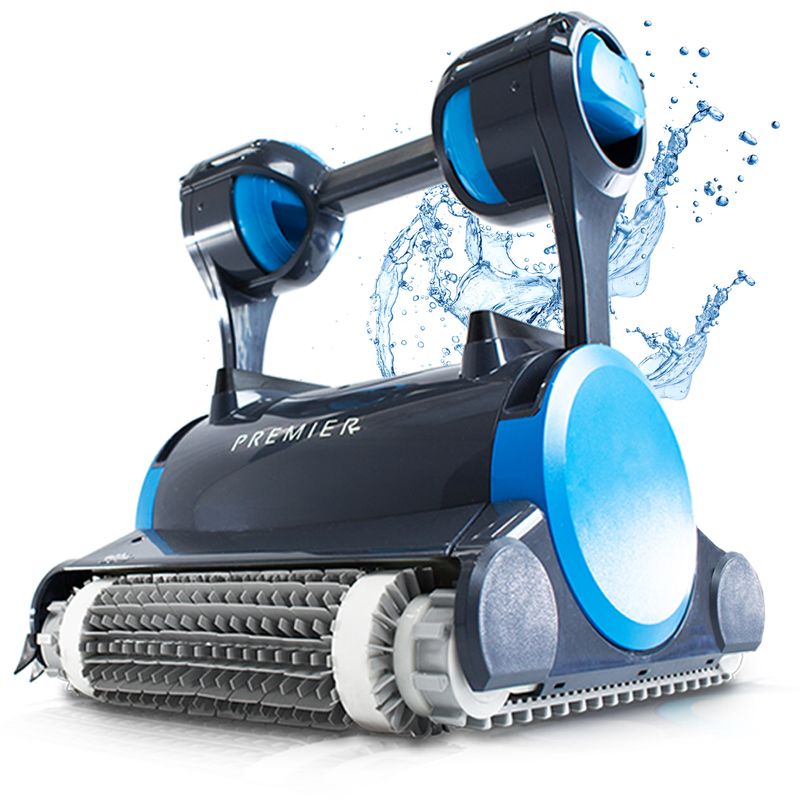
The Premier leads because it treats filtration as something you change with the season. NanoFilters come in the box for silt, dust and pollen. Standard fine filters are there for everyday cycles and an oversized leaf bag for the fall, with disposable debris bags as an optional fourth. Each swaps in seconds from the top, so running fine media once a week is no chore. Two commercial-grade ProLine motors pull 4,500 gallons per hour through whichever is fitted. Set the weekly timer on the power supply to every day through pollen season and fine material never gets the chance to build.
Temporarily out of stock
Fine filtration with the hardest scrubbing
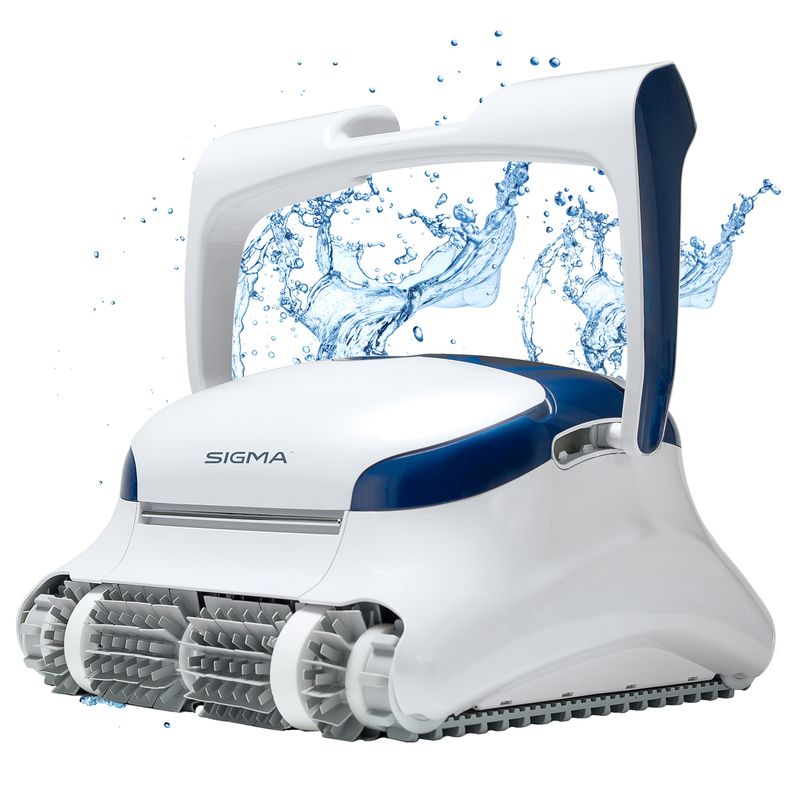
Fine debris has to be lifted before it can be filtered, and the Sigma lifts more of it. Four scrubbing brushes break the settled film on floor, walls and waterline, and three commercial-grade ProLine motors move 4,500 gallons per hour through the included NanoFilters. SmartNav 3.0 with an onboard gyroscope gives orderly coverage of the whole floor. In the myDolphin Plus app you set cycles by day and time, which lets you run it at dawn after the dust has settled, and a filter alert tells you when to rinse. It is second on price alone.
Temporarily out of stock
Most filter area, lowest 50 ft price
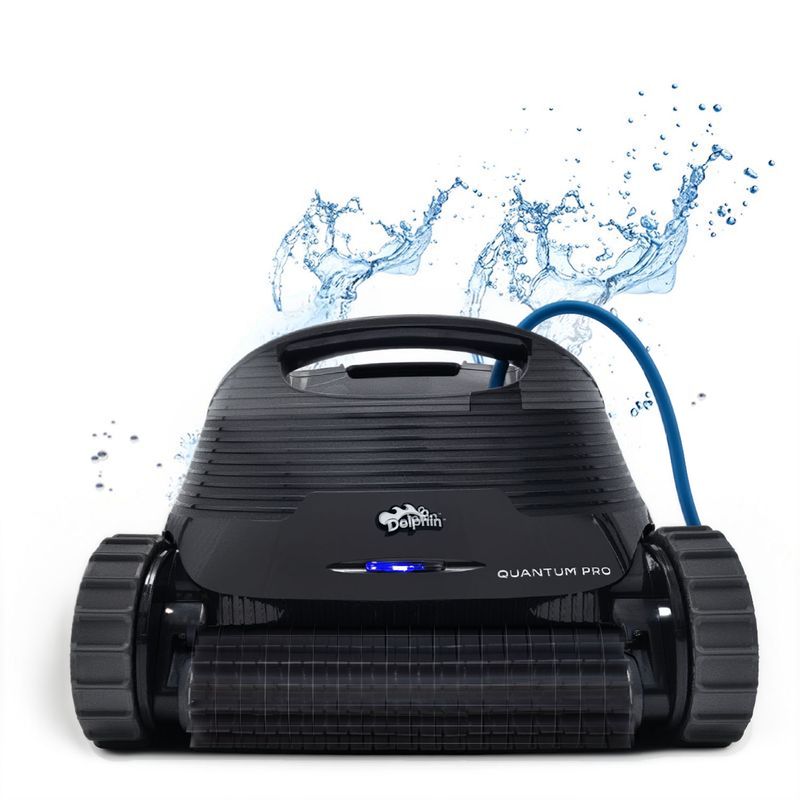
The Quantum makes the case for area. A full set of NanoFilter panels is included, and they fit the XXL MaxBin, with over 400 square inches of filter. Spread fine debris across that much media and each cycle gets further before the flow falls off. Standard panels are in the box too, so the changeover for leaf season costs nothing. Two HyperBrushes at twice standard speed loosen the film, and the basket opens with one click for the rinse. Of the three robots here with ultra-fine filtration included, it is the least expensive.

Temporarily out of stock
Add the panels and it does the job to 33 ft
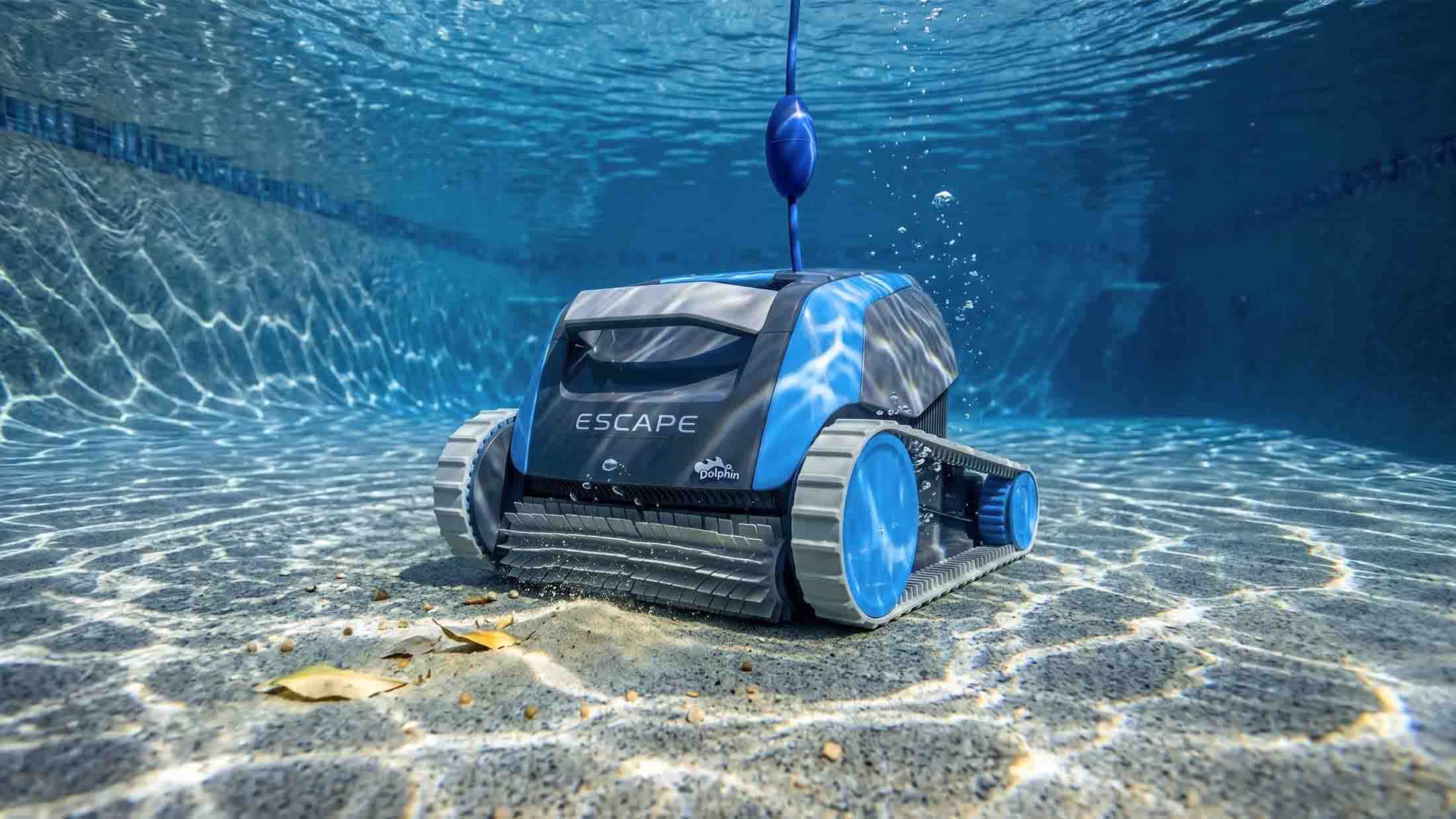
Out of the box, the Escape's MaxBin is fitted for everyday dirt, and the finest material passes through it, which is why it is fourth. Add the optional NanoFilter panels and it becomes a capable fine-debris robot for pools up to 33 ft: dual 24-volt DC motors moving over 4,000 gallons per hour, one HyperBrush at twice standard speed on floor and walls, and a top-load basket 50% larger than standard Dolphin filters. A 1.5-hour cycle and a 14.2 lb lift make the rinse-and-rerun routine easy. Check the live price on the card and add the panels when you compare.
How to judge a robot for this
Particles smaller than the openings in a filter go through it. NanoFilters are the ultra-fine media for Dolphin robots. The Premier and Sigma include them. The Quantum includes a full set of NanoFilter panels for its MaxBin. For the Escape and Cayman they are an optional add-on.
Fine media loads quickly, and a filter with more surface takes longer to choke. The Quantum's XXL MaxBin has over 400 square inches of it. A robot with less area still works. It simply needs rinsing sooner, sometimes before the cycle is over in a very dusty pool.
Fine debris clings as a film on the floor and walls. Brushes break that film loose so the flow can carry it into the filter. The Sigma has four scrubbing brushes, the Premier two, and the Quantum two HyperBrushes at twice standard speed. The Escape has one HyperBrush.
Ultra-fine filters and leaves do not mix: leaves blind the media in minutes. A robot for fine debris still needs standard filters for the weeks when trees are shedding. The first three picks include both. Keep the standard panels that come with the Escape.
Side by side
| Specification | Dolphin Premier | Dolphin Sigma | Dolphin Quantum | Dolphin Escape |
|---|---|---|---|---|
| Price today | $1949 | $2349 | $1599 | $659 |
| Filtration | Multi-Media: NanoFilters, oversized leaf bag and standard fine filters | NanoFilters and standard filter cartridges | XXL MaxBin basket with standard and NanoFilter panels | MaxBin basket; NanoFilter panels optional |
| Filter access | Top-load, no tools | Cartridges | Top-load, one-click open | Top-load |
| Brushes | Dual scrubbing brushes | Quad scrubbing brushes | Dual HyperBrush | HyperBrush |
| Flow rate | 4,500 GPH | 4,500 GPH | 4,000 GPH | Over 4,000 GPH |
| Cycle time | 3 hours | 2.5 hours | 2 hours | 1.5 hours |
| Cleans | Floor, walls and waterline | Floor, walls and waterline | Floor, walls, waterline, sun shelves and stairs | Floor and walls |
| Scheduling | Weekly timer: every day, every 2 days or every 3 days | Weekly scheduler by day and time | Weekly timer: every day, every 2 days or every 3 days | Optional Automation Timer: every 24, 48 or 72 hours |
| Warranty | 3 years | 3 years | 2 years | 2 years |
Not all haze is debris. Some of it is chemistry, and no filter fixes chemistry. A quick way to tell: look at the pool first thing in the morning, before the pump starts. If the water is clear and there is a pale layer on the floor that billows when you sweep a brush through it, that is settled fine debris, and a robot with ultra-fine filters will collect it.
If the water itself is still milky or green after a still night, the particles are too small to settle or something is growing. That calls for testing, balancing and sanitizer, and often a look at the pool's own filter. A robot does not replace any of those. It collects dead algae after a treatment has worked. It will not end a bloom that is still alive.
There is no free lunch in filtration. The same tight weave that stops silt also fills up with it, and as it fills, less water passes and the robot cleans less. In a dusty pool an ultra-fine filter can be loaded before the cycle ends. That is the filter doing its job, and the answer is a rinse, not a return.
Questions, answered
Because the particles are finer than the filter. The robot draws in water, the filter stops what is larger than its openings, and the rest leaves with the outflow. Fit ultra-fine media such as NanoFilters and that cloud is held in the filter. If it still happens, check that the panels are seated and not torn.
You can in a pool with no leaves, as long as you rinse them after every cycle. Most owners do better with a rhythm: standard filters for everyday cycles and NanoFilters once or twice a week, or daily in pollen season. Take the fine media out whenever leaves are falling.
It helps with one cause and not the others. If the cloud is settled dust, pollen or dead algae, an ultra-fine robot filter collects it over a few cycles. If it is unbalanced water, live algae or a struggling pool filter, the robot will not clear it. Test the water first.
Standard filters are the everyday set: they hold sand, grit, leaves and most visible dirt, and they keep flow high. NanoFilters are a much finer medium made for silt, dust, pollen and dead algae. They load faster and need rinsing after each cycle. A pool with fine debris wants both, used at different times.
Usually more than one. The first cycle with fine filters collects the bulk, and some of what is stirred up settles again afterward. Rinse the filter, let the pool rest, and run again the next morning.
The verdict
For fine debris, read one line of the spec sheet: are ultra-fine filters included? With the Premier they are, along with coarser media for the rest of the year. The Sigma adds the most scrubbing, and the Quantum the most filter area for the least money at 50 ft. The Escape gets there with optional NanoFilter panels, and on a pool 33 ft or under that is the sensible way to buy. Whichever you choose, rinse after every cycle.
Keep reading
