

Try it in your pool for 30 days. Exchange it for another Dolphin for free, or return it with no restocking fee.
Your bag is empty.
By feature
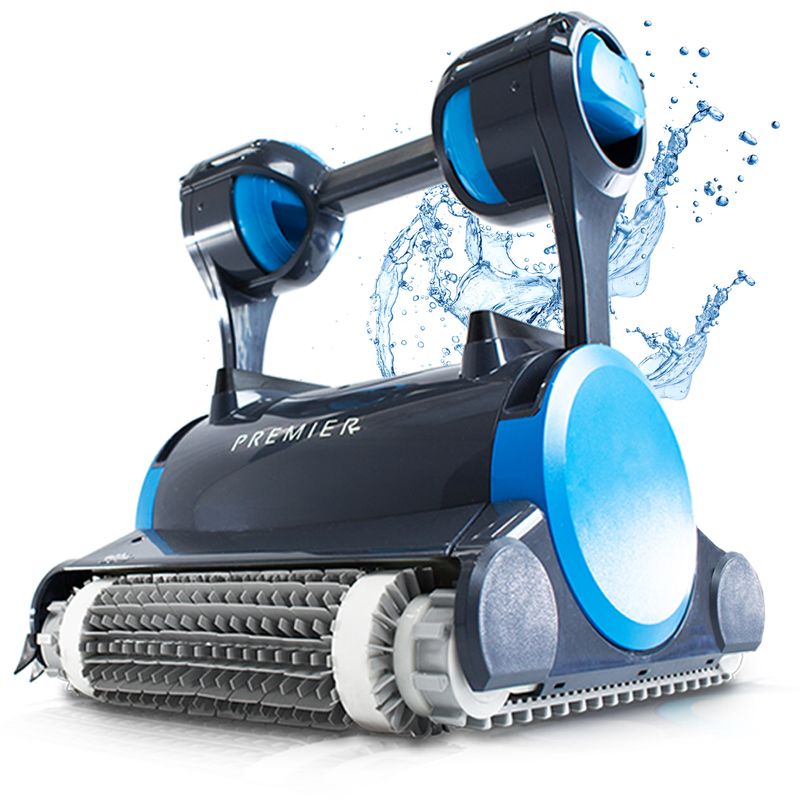
Top pick: Dolphin Premier
$1949 today · Free shipping · 30 day trial
The short answer
A swivel lets the cable untwist itself while the robot turns. Three Dolphins in this guide have one, two do not, and good cable habits help all five.
The Dolphin Premier is the pick: a 55 ft cable with a patented 360-degree anti-tangle swivel, on a robot whose 3-hour timed cycles give the swivel plenty to do. The Dolphin Sigma has the same swivel and adds gyroscope navigation at the highest price here. The Dolphin Quantum is the lowest-priced way to get a swivel. All three are in-ground robots. The Escape and Cayman have no swivel.
A pool robot turns again and again through a cycle. Every turn puts a little twist into the cable behind it, and the twist has nowhere to go. It builds until the cable winds into coils that float in a knot, shorten the robot's reach and tug it off its line. A swivel is the fix: a joint at the robot end of the cable that rotates freely, so twist spins out instead of stacking up.
That makes the best robotic pool cleaner with swivel cable a short list. Of the five Dolphins in this guide, three have one: the Premier, the Sigma and the Quantum, each on a 55 ft cable. Our own Escape does not, and neither does the Cayman. We rank the three, then give the cable habits that keep any robot from tying itself up.
Our picks, in order
Temporarily out of stock
360-degree swivel on the longest cycle
The Premier's 55 ft cable has a patented 360-degree anti-tangle swivel, the same one fitted to the Sigma, on a robot priced below it. That is the first reason it leads.
The second is how the Premier gets used. Its cycle runs 3 hours, the longest of the five, and the weekly timer on its power supply repeats that cycle every day, every 2 days or every 3 days while the robot waits in the pool. That is many hours of turning with nobody there to straighten the cable, which is the work a swivel exists for. Its published shapes include freeform and L-shaped pools, where turns come at awkward angles.
Temporarily out of stock
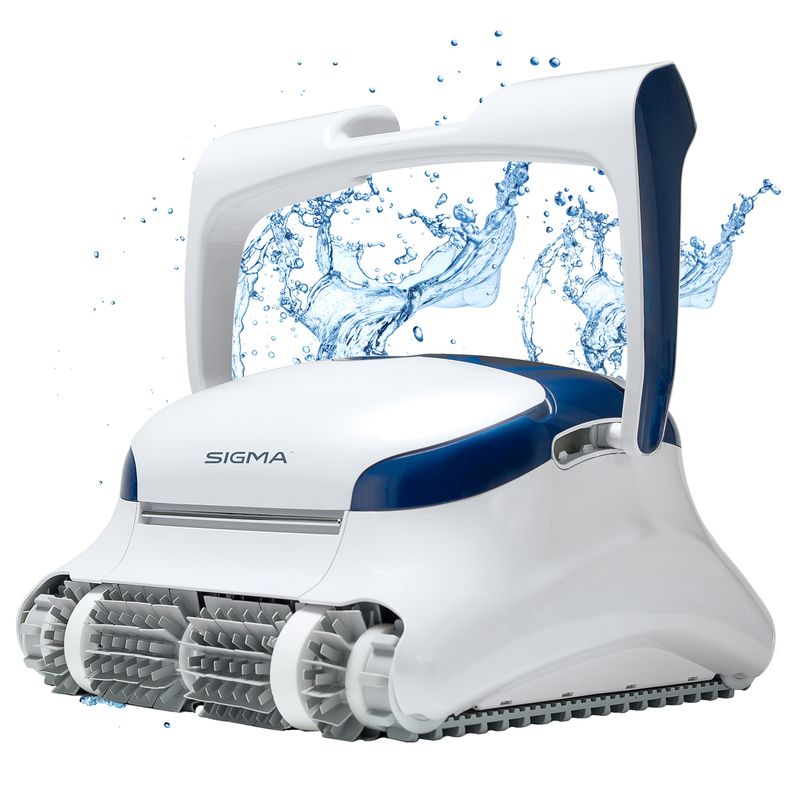
Same swivel, straighter driving
The Sigma carries the same 55 ft cable and patented 360-degree anti-tangle swivel as the Premier. What it adds comes before the cable: SmartNav 3.0 with an onboard gyroscope, which helps the robot hold a heading. A robot that keeps to its line asks less of its cable, and the swivel handles the rest.
The scheduler in the myDolphin Plus app sets cycles by day and time, so it can work unattended too. It sits second because it costs the most of the five and weighs 24.6 lb, while the swivel itself is no better than the Premier's.
Temporarily out of stock
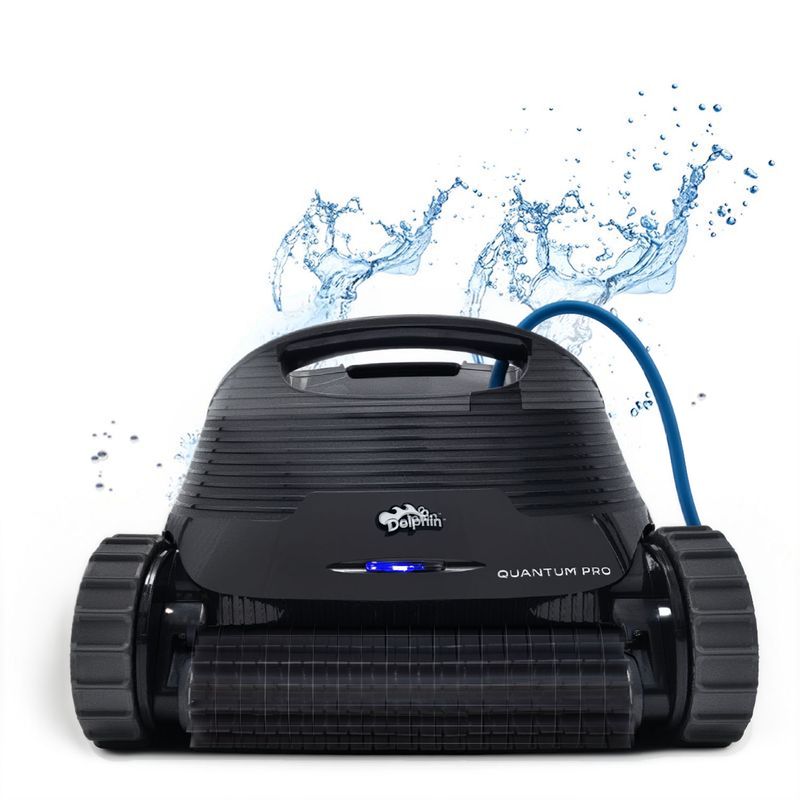
The lowest-priced swivel in this guide
The Quantum is the least robot here that comes with a swivel: a 55 ft cable with an anti-tangle swivel, on the lowest-priced 50 ft robot of the five compared. Its cycle is 2 hours, so there is less turning per run for the swivel to absorb, and SmartNav 2.0 senses ladders and drains.
It runs from its weekly timer or its Wi-Fi app, and its coverage extends to sun shelves, Baja ledges and stairs. The Premier and Sigma swivels are described as patented 360-degree units. The Quantum's is described simply as an anti-tangle swivel.
How to judge a robot for this
Tangles come from twist, not from length alone. Without a swivel, twist leaves the cable only when you pull the robot out and straighten it by hand. With a swivel, it releases as the robot works. That is the entire job of the part.
A plain rectangle produces regular turns. Freeform and round pools make a robot turn at odd angles, and a narrow pool makes it turn often. Those are the shapes where a swivel matters most.
Twist adds up with time in the water. A 3-hour cycle turns more than a 1.5-hour one, and a robot left on a timer runs cycle after cycle with nobody there to straighten the cable. Scheduled robots need the swivel most.
Spare cable floating in the pool is spare cable to loop. A 55 ft cable in a 30 ft pool should have its extra length kept on the deck. Buy enough cable to reach, then feed in only what the pool needs.
Side by side
| Specification | Dolphin Premier | Dolphin Sigma | Dolphin Quantum |
|---|---|---|---|
| Price today | $1949 | $2349 | $1599 |
| Cleans | Floor, walls and waterline | Floor, walls and waterline | Floor, walls, waterline, sun shelves and stairs |
| Scheduling | Weekly timer: every day, every 2 days or every 3 days | Weekly scheduler by day and time | Weekly timer: every day, every 2 days or every 3 days |
| App | No app; controls on the power supply | myDolphin Plus (Wi-Fi and Bluetooth) | myDolphin Plus (Wi-Fi) |
| Filtration | Multi-Media: NanoFilters, oversized leaf bag and standard fine filters | NanoFilters and standard filter cartridges | XXL MaxBin basket with standard and NanoFilter panels |
| Brushes | Dual scrubbing brushes | Quad scrubbing brushes | Dual HyperBrush |
| Navigation | SmartNav 2.0 | SmartNav 3.0 with gyroscope | SmartNav 2.0 |
| Cable | 55 ft with 360° anti-tangle swivel | 55 ft with 360° anti-tangle swivel | 55 ft with anti-tangle swivel |
| Warranty | 3 years | 3 years | 2 years |
Three things put twist into a cable. The robot's own turning is the first. The second is storage: a cable wrapped tightly around an elbow or the power supply takes a set, and it goes back into the pool already wanting to coil. The third is slack. Loose cable on the surface drifts into loops, and a loop that tightens becomes a knot.
A swivel deals with the first cause. It does nothing about the other two, which is why owners of swivel robots still see tangles when the cable is stored badly. Those two causes cost nothing to fix.
These apply to all five robots in this guide. They matter most on the Escape and Cayman, which depend on them.
A swivel does not add reach. If the cable cannot get from the power supply to the far end of the pool, the robot will miss that end whatever joint it has. Measure the run first. The power supply has to sit back from the water by the distance given in the manual, and that setback comes out of your cable length.
It does not stop snags either. A floating cable can still hook a ladder, a handrail or a skimmer mouth. And it does not make an in-ground robot right for an above-ground pool. For that, see the Dolphin Escape and manage the cable by hand.
Questions, answered
It lets the cable rotate at the robot end, so the twist created by hours of turning spins out instead of winding the cable into coils. With a robotic pool cleaner with swivel cable you spend less time untangling, and the robot is less likely to be pulled off course by its own cord.
Two of the five. The Escape has a 40 ft cable described as tangle-resistant, with no swivel. The Cayman's 50 ft cable has no swivel either. Both are shorter-cycle robots for pools up to 33 ft, and both stay manageable with two habits: straighten the cable before use and keep spare length out of the water.
Usually storage or slack. A cable wound tightly between uses takes a set, and a swivel cannot remove that. Too much cable in the water also drifts into loops. Lay the cable straight on the deck for an afternoon, coil it loosely from then on, and feed in only what the pool needs.
No. The cable has to reach the far end of the pool with the power supply set back from the water, and that is all. Anything beyond is spare length to manage. A 55 ft cable suits a 40 or 50 ft in-ground pool. In a 24 ft round, 40 ft may already be plenty, depending on where the outlet is.
Less than you would in a freeform one. A rectangle gives the robot regular turns, and good cable habits go a long way. A swivel still earns its place if the pool is long, the cycles are long, or the robot runs on a timer while you are away.
The verdict
Buy a swivel when the pool is in-ground and the robot will run long or unattended, or when the shape is freeform, L-shaped or narrow. The Premier is the pick. Choose the Sigma if you also want a gyroscope, or the Quantum to spend the least. If the pool is above-ground, no swivel robot here fits it. If it is in-ground and 33 ft or under, a swivel is optional: the Escape plus a minute of cable care does the job for less.
Keep reading
