

Try it in your pool for 30 days. Exchange it for another Dolphin for free, or return it with no restocking fee.
Your bag is empty.
By pool shape and design
Top pick: Dolphin Cayman
$1049 today · Free shipping · 30 day trial
The short answer
A plunge pool is short on floor and long on wall, so the right robot is a small, light one that climbs well and lifts out easily.
The Dolphin Cayman is the right-sized robot for most plunge pools: rated for in-ground pools up to 33 ft, a 2-hour floor-and-wall cycle, 14.6 lb, and a timer that runs it every day. Pick the Dolphin Escape for the lowest spend if your pool is fiberglass, tile, gunite or vinyl. Step up to the Dolphin Quantum only if you want the waterline scrubbed too, with the best odds on the bench.
Robot sizing advice usually starts with pool length. For a plunge pool that question answers itself: at 8 x 12 ft or 10 x 20 ft, every robot here is rated for a pool several times longer. So the best robotic pool cleaner for plunge pools is not the one with the biggest numbers. It is the smallest, lightest one that suits what a plunge pool is: a little floor at the bottom of a lot of wall.
Depth is the other half. Plunge pools run 4 to 7 ft deep, often with a bench down one side, and many are heated or chilled. So the robot spends most of its cycle climbing, the cable has to reach down as well as across, and the water temperature needs checking against the manual. The Premier and Sigma would clean one, but at 20 lb or more they are more robot than this pool can use.
Our picks, in order
Temporarily out of stock
Right-sized for a built-in plunge pool
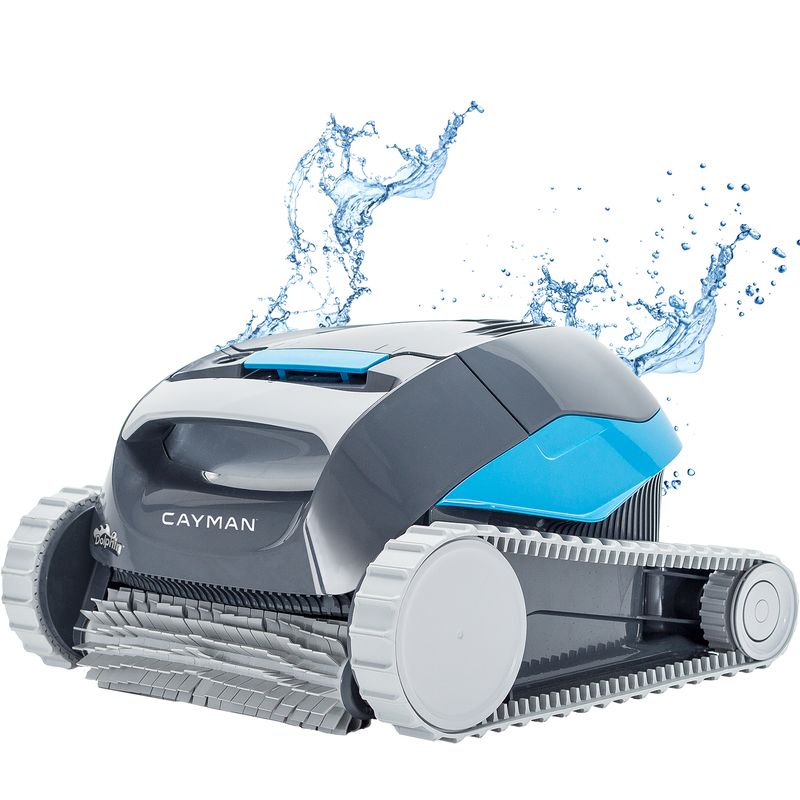
The Cayman is rated for in-ground pools up to 33 ft, which covers any plunge pool with room to spare, and its published surfaces include the plaster, pebble and concrete finishes most built-in plunge pools use. The 2-hour cycle gives its HyperBrush, spinning at twice the speed of a standard Dolphin brush, time to work every tall wall on HyperGrip tracks.
The details suit a small pool as well: a timer on the power supply that runs a cycle every day with no phone involved, a MaxBin that empties through a top hatch with one tab, and a 50 ft cable that leaves slack for a deep floor.

Temporarily out of stock
Lowest spend that still climbs every wall
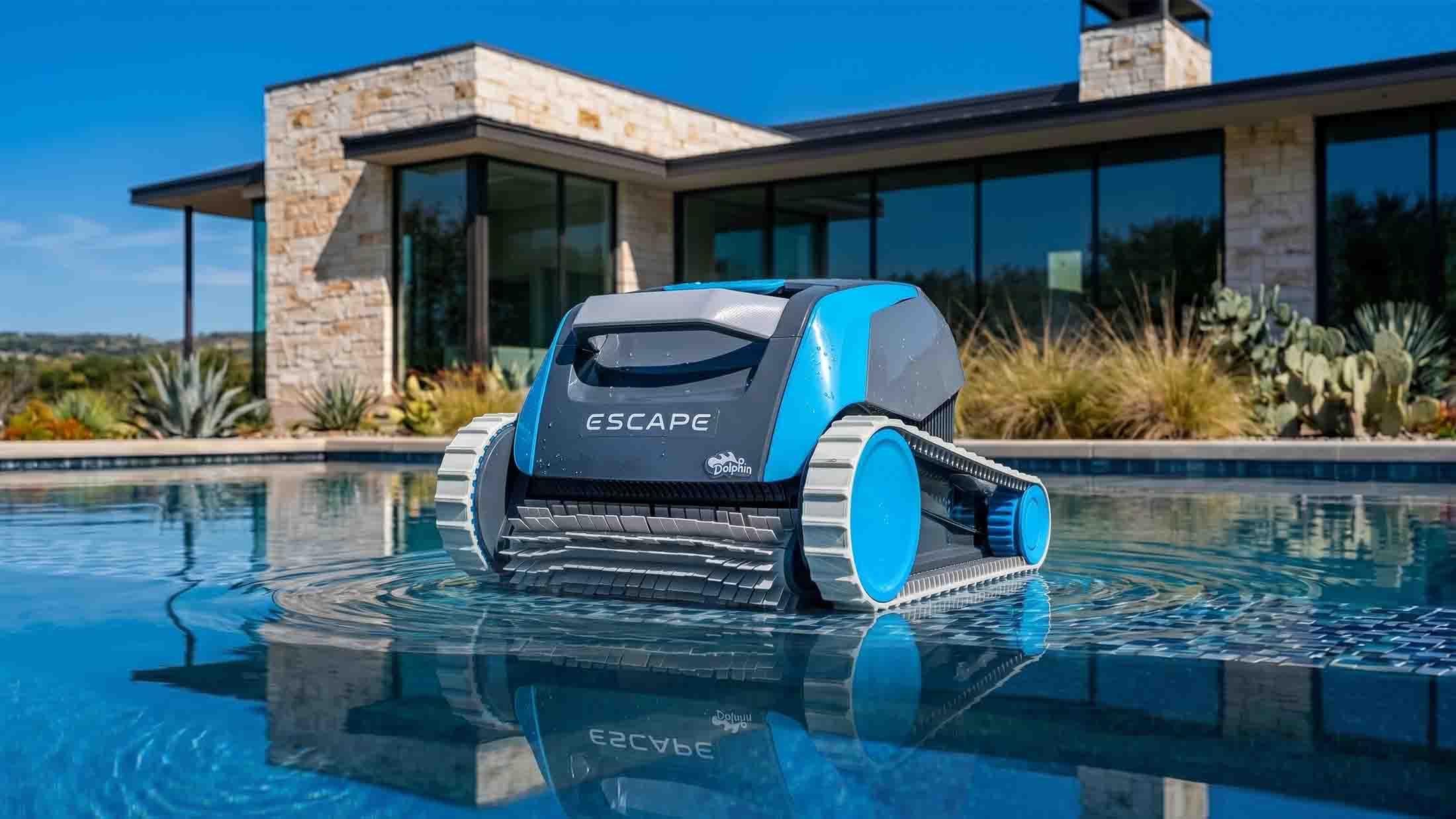
The Escape is the lowest-priced pick here and gives up less than the gap suggests. It has the same HyperBrush, the same dual 24-volt DC motors moving over 4,000 GPH, the same HyperGrip tracks and the same size of MaxBin basket as the Cayman. Its cycle is 1.5 hours, which on a floor of 200 square feet or less is still plenty of passes.
At 14.2 lb it is the lightest robot in this guide, and its 40 ft cable reaches around most plunge pools once the power supply is set back from the edge. Its published surfaces are vinyl liner, gunite, fiberglass and tile.
Temporarily out of stock
For the waterline, with the best odds on a bench
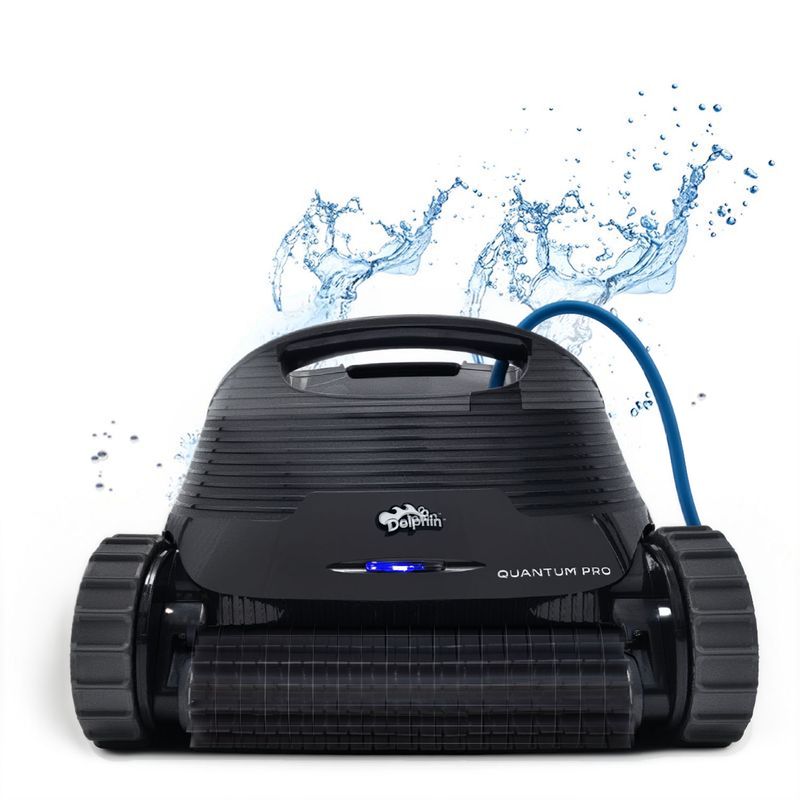
The Quantum is here for what it cleans, not for its size. Its published coverage names floor, walls, waterline, sun shelves, Baja ledges and stairs, so it is the one pick with a claim on a plunge pool's bench and the tile band above it. Dual HyperBrushes and an included set of NanoFilter panels deal with the fine dust that shows quickly in a small, clear pool.
Its 55 ft cable has an anti-tangle swivel, useful where a robot turns every few feet, and the myDolphin Plus app starts or schedules a cycle over Wi-Fi.
How to judge a robot for this
Take an 8 x 12 ft plunge pool that is 5 ft deep. The floor is 96 square feet; the four walls add up to about 200. A robot in that pool is a wall climber first, so track grip, brush speed and cycle time matter more than its length rating.
Built-in plunge pools are usually plaster, pebble or tile; drop-in units are often fiberglass. The Cayman's published surfaces cover concrete, plaster, gunite, pebble, tile, vinyl liner and fiberglass. The Escape's list is vinyl liner, gunite, fiberglass and tile. Match the list to your finish first.
In a pool this small the robot shares the water with the people using it, so it gets lifted out often. The Escape weighs 14.2 lb, the Cayman 14.6 lb and the Quantum 18.3 lb, and each comes up heavier until the water drains from it.
The Cayman and Escape clean floor and walls and stop below the waterline. Of the three picks, only the Quantum's published coverage adds the waterline, sun shelves, Baja ledges and stairs. Heated and chilled plunge pools should also be checked against the water-temperature range in the robot's manual.
Side by side
| Specification | Dolphin Cayman | Dolphin Escape | Dolphin Quantum |
|---|---|---|---|
| Price today | $1049 | $659 | $1599 |
| Navigation | SmartNav 2.0 | SmartNav 2.0 | SmartNav 2.0 |
| Cable | 50 ft | 40 ft | 55 ft with anti-tangle swivel |
| Pool length | Up to 33 ft | Up to 33 ft | Up to 50 ft |
| Cleans | Floor and walls | Floor and walls | Floor, walls, waterline, sun shelves and stairs |
| Cycle time | 2 hours | 1.5 hours | 2 hours |
| Scheduling | Timer: every day | Optional Automation Timer: every 24, 48 or 72 hours | Weekly timer: every day, every 2 days or every 3 days |
| Warranty | 2 years | 2 years | 2 years |
Measure three things: the deepest point, the bench (its width and the water over it at normal fill) and the route from the outlet to the water.
The power supply has to sit back from the pool edge by the distance your manual gives. As an example only, call it roughly 12 ft. From the Escape's 40 ft cable that leaves about 28 ft in the water. In a 10 x 20 ft pool that is 7 ft deep, with the power supply opposite the middle of a long side, the farthest floor corner is about 14 ft across the surface and 7 ft down, which fits. With the outlet at one end, or farther back, the Cayman's 50 ft cable is the safer margin.
A plunge pool's small volume is why it can be held at a temperature a full-size pool could not afford, and why temperature belongs on your checklist. The manual for each robot states the water temperatures it is meant to work in. If you keep the water very warm for soaking or very cold for recovery, read that range first. A tub-sized cold plunge has no room for a robot to turn; wipe it down instead.
Small volume also means chemicals shift the water quickly. Take the robot out before shocking or adding chemicals. If the pool has an automatic or fitted cover, lift the robot and its cable out before the cover closes.
A robot takes over the floor and the walls. A few jobs stay with you.
Questions, answered
Need, no. A plunge pool is small enough to brush and vacuum by hand. What a robot buys you is the walls: 4 to 7 ft of depth is awkward to scrub from the deck, and a robot climbs it every cycle. Used most days or under trees, a robot earns its keep; used a few times a month, a brush may be enough.
Yes. All three picks climb walls on HyperGrip tracks. The difference is where they stop: the Cayman and Escape stop short of the waterline, and the Quantum carries on to scrub it.
Only inside the water-temperature range printed in the robot's manual. We do not quote a number because none is published on the spec sheets we work from. If your pool is chilled or heated well beyond normal swimming temperatures, check the manual before the first cycle, or talk to a Dolphin Expert and we will look it up with you.
Yes, if it runs on a timer or app schedule: those robots are made to wait in the water for the next scheduled cycle. In a plunge pool you will likely want it out before a soak, which is fine. Lift it out at least weekly to rinse the filter, take it out before shocking, and store it dry and out of the sun when the pool sits unused for a long stretch.
The verdict
Buy for the walls and the lift, not the length rating. Plaster, pebble or concrete, or a cycle every day without thinking about it: the Cayman. Fiberglass, tile or vinyl, and you would rather keep the money: the Escape is enough. Pay for the Quantum only when the waterline is a job you want off your list and you want the best odds on the bench. Every robot ships free by FedEx in the contiguous US in 1 to 3 days.
Keep reading
