

Try it in your pool for 30 days. Exchange it for another Dolphin for free, or return it with no restocking fee.
Your bag is empty.
By budget
Top pick: Dolphin Escape
$659 today · Free shipping · 30 day trial
The short answer
Nothing here costs under $300, so this page explains what that money buys, what it leaves out, and the lowest-cost way into a robot that climbs walls.
No robot we recommend costs under $300. At that price the market is small battery-powered units and basic floor-only cleaners. The closest pick is the Dolphin Escape, the lowest-priced robot in this guide: it cleans floor and walls on a 1.5-hour corded cycle and carries a 2-year warranty. It costs more than $300, so check the live price on the card and the certified open-box listings.
No robot recommended on this page costs under $300. The closest pick is the Dolphin Escape, and it costs more than this budget. We would rather say so up front than recommend a machine we do not believe in. Check the live price on the card, and look at certified open-box or refurbished stock to narrow the gap.
Here is the honest answer first: no robot recommended on this site costs under $300, and we are not going to pretend one does. If you searched for the best robotic pool cleaner under $300, you deserve to know what that budget actually buys before you spend it.
Under $300, the market is mostly small battery-powered units and basic cleaners that work the floor only. They run for a short time, they do not climb walls, and their filters are small. For a small, flat-bottomed pool that collects a little grit, that can be enough. For anything bigger, most of the pool stays untouched. The nearest robot we stand behind is the Dolphin Escape. It costs more, and this page explains exactly what the difference pays for.
Our picks, in order

Temporarily out of stock
Closest pick, above the $300 line
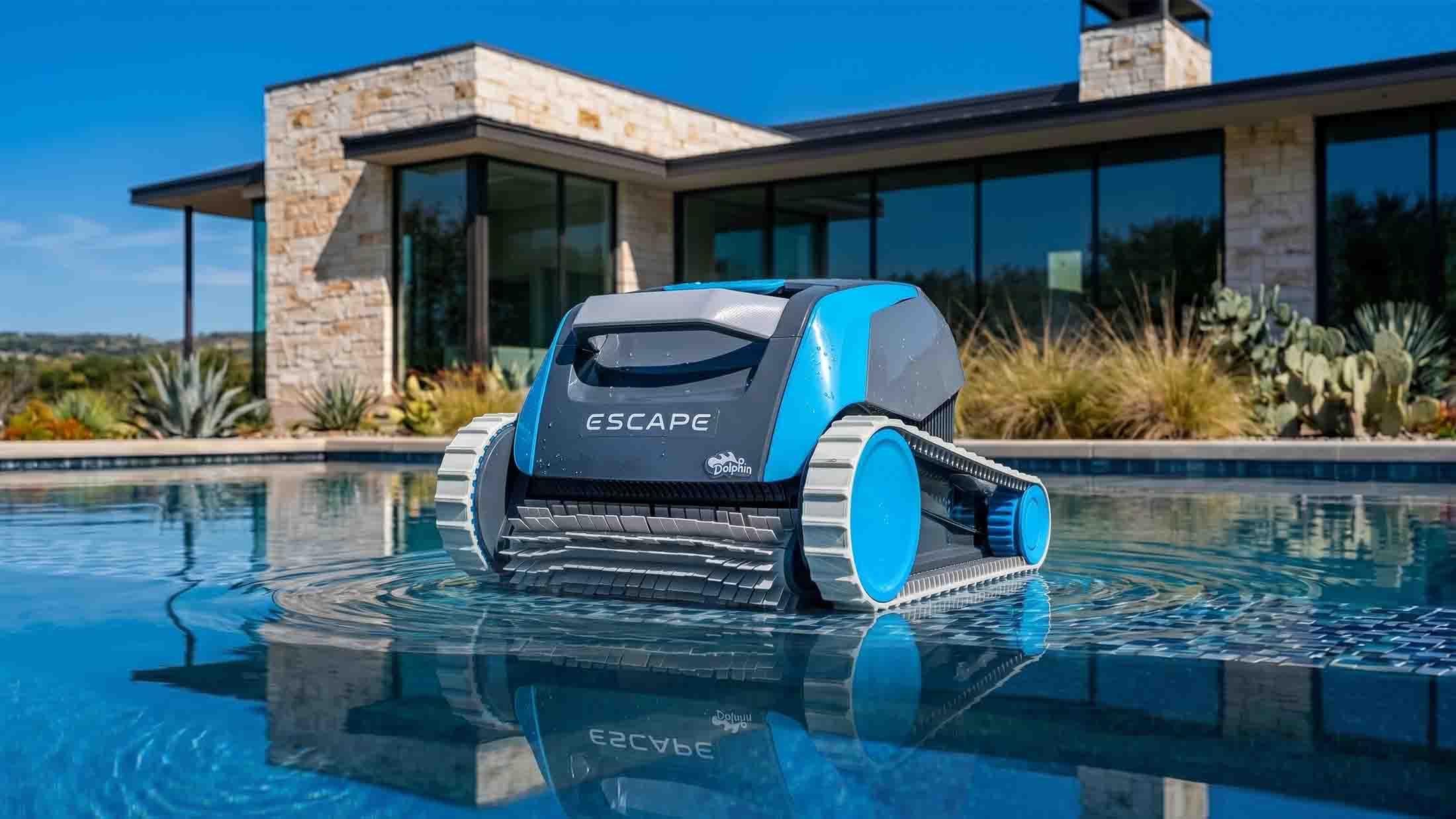
The Escape is the lowest-priced robot in this guide and the nearest thing here to a $300 budget, though it costs more than that. What the extra money buys is plain. It climbs and scrubs walls as well as the floor, in above-ground and in-ground pools up to 33 ft. It runs a full 1.5-hour cycle on a cord, so there is no battery to charge or wear out. And it carries a 2-year warranty.
The hardware is not entry-level: a HyperBrush that spins at twice the speed of standard Dolphin brushes, dual 24-volt DC motors moving over 4,000 GPH, HyperGrip tracks and a top-load MaxBin basket 50% larger than standard Dolphin filters.
How to judge a robot for this
The floor is the easy part. Walls collect a film the floor never shows, and they are the surface you would otherwise brush by hand. Cleaners at this price generally stay on the floor. Climbing takes tracks, grip and enough water flow to hold the machine against a vertical surface.
A battery puts a clock on every clean. When the charge runs out the session is over, finished or not, and the unit goes back on its charger. A corded robot draws from a standard outlet through its power supply and runs its full cycle every time.
Small units carry small filters. In a yard with trees, a small filter fills fast, and a full filter stops collecting. Look at how much the basket holds and how it comes out. A large basket that lifts from the top means fewer interruptions.
Ask two things of any cleaner: how long is the warranty, and are brushes, tracks and filters sold as spares? Short coverage is common at the bottom of the market. A longer warranty and replaceable wear parts cost more on day one and can cost less per season.
We will not name brands, because the category matters more than the label. A cleaner under $300 can be a fair buy for the right pool: small, flat-floored, lightly used, with an owner who does not mind brushing the walls. It is not a substitute for a wall-climbing robot in a full-size pool. At this budget you will mostly find two kinds.
Price tags hide the real comparison, which is what the cleaner does with each hour in the water. The table sets a typical under-$300 cleaner, described in general terms, against the Escape's published specs. The left column describes a category, not any one product, so check the listing of anything you are considering. The right column comes from the Escape's spec sheet. Read across each row and ask which difference you would notice in your own pool. For a full-size pool it is usually the walls first, then the warranty.
| Feature | Typical cleaner under $300 | Dolphin Escape |
|---|---|---|
| Surfaces cleaned | Floor only | Floor and walls |
| Power | Battery, or a basic cord | Corded, from a standard outlet |
| Run time | Short, limited by the charge | 1.5-hour cycle |
| Filter | Small | Top-load MaxBin, 50% larger than standard Dolphin filters |
| Pool size | Small pools | Above-ground and in-ground pools up to 33 ft |
| Warranty | Often short | 2 years |
If $300 is the real ceiling, you have options, and only one of them means spending more today.
Questions, answered
There are cleaners under $300, and some suit small, simple pools. None is a robot we recommend. At that price, expect a small battery unit or a basic floor-only cleaner with a small filter and a short run time. The lowest-priced robot in this guide costs more and adds wall cleaning, a 1.5-hour corded cycle and a 2-year warranty.
Climbing a wall takes grip, enough water flow to hold the machine against a vertical surface, and navigation that knows when to turn back. Those parts cost money and add weight. Small low-priced units leave them out. The Escape climbs with HyperGrip tracks and dual 24-volt DC motors moving over 4,000 GPH, which is part of why it costs more.
For a small pool with light debris, a battery unit can be a reasonable convenience. The limits are built in: the session ends when the charge does, the filter is small, and most stay on the floor. If you want walls cleaned and a full cycle every time, a corded robot is the better tool, and every robot in this guide is corded.
It is the most sensible way to close a budget gap when stock is available, because a certified unit is listed below the price of a new one. Read the listing for the condition and the warranty that applies to that unit. Stock is limited and changes often, so check the open-box and refurbished pages before you count on one.
If your current routine works and the budget is fixed, waiting is a sound plan. A manual vacuum costs you time, not money. Buying a floor-only cleaner now and a wall-climbing robot later means paying twice. If the choice is a cleaner you already doubt or one more season with the pole, keep the pole and save toward the Escape.
The verdict
Under $300 buys a floor-only cleaner for a small pool, and we have none to recommend. If that matches your pool and your expectations, buy one with open eyes. If you want walls cleaned, a full cycle from a cord and a 2-year warranty, the Escape is the least robot that delivers them, and it costs more than this budget. Close the gap with certified open-box or refurbished stock, or by waiting a season. Talk to a Dolphin Expert if you want help deciding.
Keep reading
